Few figures in history are as universally recognized or as frequently misunderstood as Albert Einstein. His name, synonymous with unparalleled genius and revolutionary scientific insight, has become inextricably linked with the advent of the atomic age. The iconic equation, E = mc², a cornerstone of modern physics, is often the first thought that comes to mind when discussing nuclear energy or the cataclysmic power of atomic bombs. This ubiquitous association has, over decades, fostered one of history's most persistent and pervasive misconceptions: that Einstein himself was instrumental in the design, development, or construction of the atomic bomb. The reality, however, is far more intricate and, in many respects, profoundly more compelling than the popular narrative suggests.
Contrary to popular belief, Albert Einstein never participated in the clandestine laboratories of the Manhattan Project, nor did he contribute a single calculation or engineering design to the creation of the world's first nuclear weapon. His involvement was singularly constrained to a pivotal, yet indirect, action that would weigh heavily on his conscience for the remainder of his life: appending his signature to a letter that warned the United States government of the ominous possibility that Nazi Germany might be engaged in a desperate race to develop its own atomic bomb. This singular act, born out of a profound sense of fear and moral obligation, stands in stark contrast to the widespread image of Einstein as the 'father of the atomic bomb.' Indeed, the very scientist often depicted as the architect of this destructive power dedicated a significant portion of his later life to vehemently opposing the proliferation of the very weapons his name had inadvertently become associated with. His legacy, when viewed through an accurate lens, becomes less a tale of invention and more a testament to moral conviction, highlighting the often-divergent paths of scientific discovery and geopolitical decision-making.
The reasons behind Einstein's non-participation in the atomic bomb project are multifaceted, encompassing both practical scientific distinctions and formidable political barriers. Fundamentally, Einstein was a theoretical physicist, a conceptual architect of the universe whose groundbreaking theories fundamentally reshaped humanity's understanding of space, time, gravity, and energy. His work provided the intellectual framework for understanding the immense energy locked within the atom, but it did not, by any means, offer a blueprint for weapon construction. Designing a functional atomic bomb demanded an entirely different spectrum of expertise: experimental physics to validate theoretical predictions, intricate engineering for weapon mechanisms, advanced metallurgy for material development, complex chemistry for isotope separation, and unprecedented levels of large-scale industrial coordination for mass production. These were disciplines far removed from Einstein's primary intellectual pursuits, and he neither possessed the practical skills nor harbored the inclination for such a colossal undertaking in applied technology and military engineering.
Beyond these practical considerations, a significant political impediment effectively barred Einstein from any direct involvement in classified wartime projects. Despite having fled the escalating persecution of Nazi Germany and subsequently becoming a naturalized American citizen, Einstein never managed to secure the requisite security clearance to participate in the top-secret Manhattan Project. This denial stemmed largely from deep-seated suspicion within American governmental circles, particularly from the Federal Bureau of Investigation (FBI). Under the pervasive influence of its director, J. Edgar Hoover, the FBI maintained an extensive and highly detailed surveillance file on Einstein, which eventually swelled to well over a thousand pages. His outspoken political views, which included fervent support for civil rights, a staunch commitment to pacifism, and perceived associations with a wide array of humanitarian and intellectually 'left-leaning' organizations, rendered him a figure of profound governmental distrust during an era of heightened wartime paranoia.
Authorities viewed his avowed pacifism, expressed consistently throughout his public life, as a potential liability rather than a principled stance. His connections to various academic and activist circles, often engaged in discussions deemed unconventional or even subversive by the establishment, further solidified this suspicion. As Peter Klarnet, a senior specialist at Christie's, observed, Einstein's overt left-leaning political beliefs were a decisive factor in his denial of security clearance. The irony was profound: a preeminent scientist, whose intellectual contributions laid the very groundwork for understanding nuclear energy and who had sought refuge in America from totalitarianism, found himself systematically excluded from the nation's most critical wartime scientific endeavor due to political vetting. He himself later emphasized that his part in the release of atomic energy was 'quite indirect,' a testament to this enforced distance.
Thus, the narrative of Einstein's direct involvement in building the atomic bomb collapses under the weight of historical scrutiny. His true connection to this epoch-defining weapon lies not in its construction, but in a single, desperate appeal made during one of the twentieth century's most perilous junctures. In the summer of 1939, as Europe teetered on the brink of another devastating war and the ominous shadow of Nazi aggression lengthened, Hungarian physicist Leo Szilard became deeply alarmed. Having grasped the implications of recent breakthroughs in nuclear fission research – particularly the successful demonstration of nuclear fission in Germany by Otto Hahn and Fritz Strassmann in late 1938 – Szilard foresaw the terrifying possibility that Adolf Hitler's regime could weaponize uranium, developing an atomic bomb capable of unimaginable destruction. He recognized that such a weapon in Nazi hands would undoubtedly spell catastrophe for global civilization.
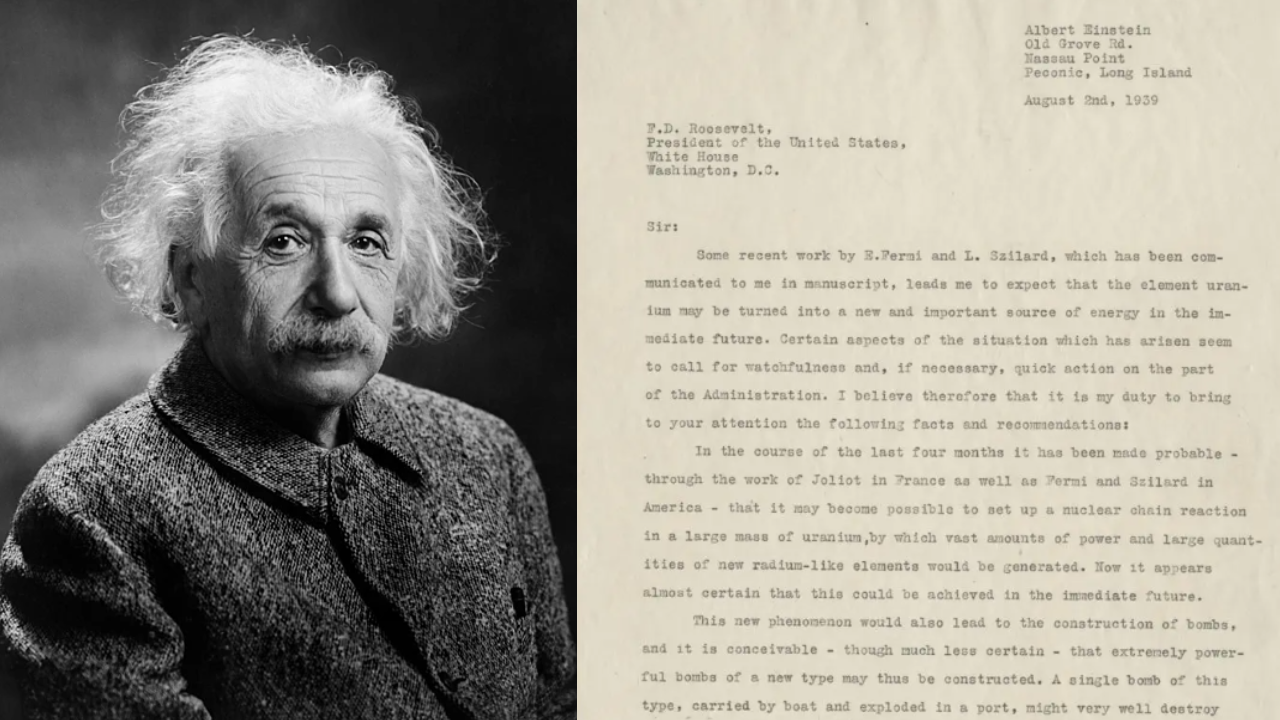
Grappling with this profound existential threat, Szilard understood that a warning to the United States government needed to carry immense weight and authority to be taken seriously. He approached Albert Einstein, recognizing that Einstein's unparalleled international scientific reputation and moral stature would ensure that any communication bearing his signature would command immediate and serious attention from the highest levels of American leadership. The resulting correspondence, known as the Einstein-Szilard letter, was addressed to then-U.S. President Franklin D. Roosevelt. This urgent missive implored the American government to acknowledge the severe threat posed by Germany's potential nuclear ambitions and to commit substantial resources to uranium research and development before the Nazis could gain an irreversible advantage. Historians widely regard this letter as a pivotal event that significantly influenced the United States' decision to initiate its own atomic research efforts, which subsequently burgeoned into the colossal undertaking of the Manhattan Project.
It is imperative to understand that Einstein's decision to sign this letter was not motivated by scientific ambition or an eagerness to usher in a new era of weaponry. Instead, it was driven by an overwhelming sense of fear and a grim calculation of the lesser of two evils. He genuinely believed that if Nazi Germany succeeded in developing an atomic bomb first, the consequences for humanity would be unspeakably catastrophic. His signature was, therefore, an act of preemptive caution, a desperate plea to counterbalance a terrifying hypothetical threat. Once the Second World War concluded, and it became unequivocally clear that Germany had never come close to producing such a weapon, Einstein's perspective on his fateful involvement shifted dramatically. Reflecting on his decision in a 1947 interview, he candidly admitted,
source: Times of India