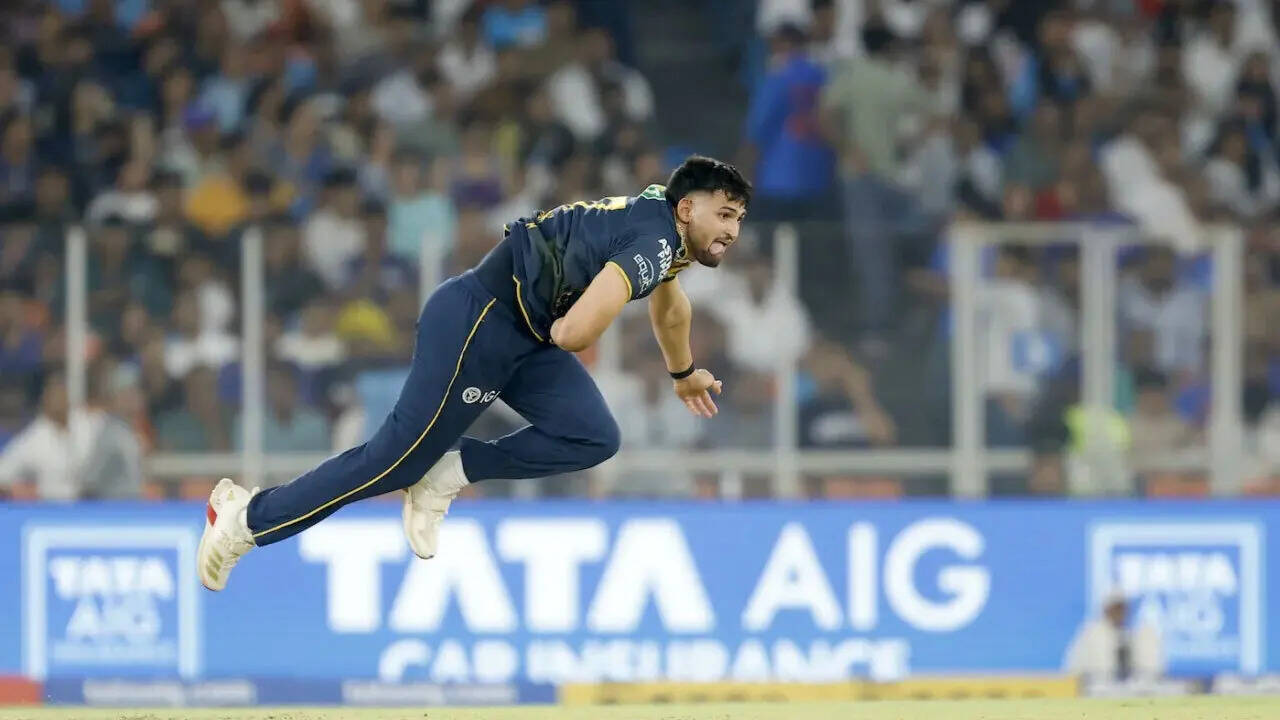
The landscape of Indian cricket is perpetually on the hunt for genuine fast bowlers, individuals who can consistently breach the 145 kph barrier and unsettle opposition batters with sheer velocity. In this quest, a new beacon of promise has emerged in the form of Ashok Sharma, whose rapid ascent from the domestic circuit to the national team has captivated observers. Sharma, a 23-year-old speedster, is not merely content with his current blistering pace, already recorded at an impressive 154.2 kph; he harbors an audacious ambition to one day touch the rarefied mark of 160 kph, a speed that would place him among the fastest bowlers in cricketing history.
Sharma's journey to the cusp of international cricket has been marked by a blend of raw talent, unwavering dedication, and a discerning approach to learning. His recent maiden call-up to the Indian squad for the upcoming three-match T20I series against Zimbabwe, commencing on July 23rd, is a testament to his consistent performances and an undeniable trajectory of improvement. This national recognition follows a period of intense activity and remarkable achievements, solidifying his reputation as one of the most exciting fast-bowling prospects in the country.
Just a few months prior, Sharma found himself in a peculiar state of anticipation, a mixture of hope and burgeoning excitement. The Board of Control for Cricket in India (BCCI) had requested his passport for a potential tour to Ireland, an administrative step that ignited significant aspirations for the young pacer. It was an experience entirely new to him, a tangible sign that his efforts were being noticed at the highest levels. Reflecting on that moment from Bengaluru, where he is currently competing in the Emerging Men's tournament, Sharma shared his initial optimism. "My hopes were incredibly high because all of this was happening for the very first time," he recounted, emphasizing the novelty of the situation. Despite his elevated expectations, a spot in the Ireland touring party ultimately eluded him. However, rather than succumbing to disappointment, Sharma exhibited a profound maturity and patience, understanding that numerous cricketing opportunities lay ahead. His conviction that his chance would eventually materialize proved prescient.
Indeed, the preceding nine months have been nothing short of transformative for Ashok Sharma. He transitioned from being a promising domestic talent to a fully-fledged national fast-bowling prospect with astonishing speed. His performances in the Syed Mushtaq Ali Trophy, India's premier domestic T20 competition, were particularly noteworthy. Representing Rajasthan, Sharma shattered an 11-year-old tournament record by claiming an astounding 22 wickets, a feat that underscored his effectiveness and wicket-taking prowess in the high-pressure T20 format. This exceptional display did not go unnoticed, earning him significant attention and paving the way for his entry into the glamorous Indian Premier League (IPL).
In the IPL, Sharma's express pace became a talking point, particularly during his stint with the Gujarat Titans. His ability to consistently deliver rapid deliveries turned heads and showcased his potential on a grander stage. This period of rapid growth culminated in an India A call-up, initially as an injury replacement, which provided him with invaluable exposure and further opportunities to hone his skills. Now, with a senior national team call-up in his pocket, Sharma's journey has reached a significant milestone, yet he views it merely as the beginning.
At the core of Sharma's success is his unwavering commitment to raw pace. He views speed not just as an attribute but as his primary weapon, one that he resolutely refuses to compromise. His training philosophy is singularly focused on enhancing this fundamental aspect of his bowling. "I never want to compromise on my pace. My focus is always on improving my bowling. If everything goes well, maybe I can touch 160 kph one day, but I don't think too much about that. I just want to keep getting better and become more skilful," Sharma asserted, articulating a disciplined approach that prioritizes foundational strengths while allowing for aspirational targets.
The pursuit of 160 kph is a testament to the modern fast bowler's ambition and the increasing demands of international cricket. Only a handful of bowlers globally have ever officially recorded speeds in this elite bracket, making it a benchmark of extraordinary physical prowess and technical efficiency. Sharma's current best of 154.2 kph already puts him in an exclusive group of rapid Indian pacers, and his drive to push that boundary further highlights a rare blend of talent and mental fortitude. Achieving such speeds requires not only immense physical strength and a perfectly synchronized bowling action but also a deep understanding of biomechanics and injury prevention, areas where Sharma is evidently committed to continuous improvement.
Sharma's brief stint with the India A team for a tour to Sri Lanka, led by Tilak Varma, provided him with his first taste of overseas cricketing conditions. He fondly recalls the experience, describing it as "great" and "very special." Representing his country for the first time was a momentous occasion, one filled with enjoyment and a sense of pride. During this tour, a spectacular catch he took in India A's crucial match against Afghanistan A garnered widespread attention, with a reel of the athletic fielding effort going viral across social media platforms. This incident not only highlighted his all-round athleticism but also added to his burgeoning public profile.
Joining the India A squad as an injury replacement for Yudhvir Singh proved to be a pivotal learning experience. The tour offered him the invaluable opportunity to work closely with Lakshmipathy Balaji, a former India pacer who served as the bowling coach for the India A team. Balaji's approach, as described by Sharma, was centered on refinement rather than radical alteration. "It was a great experience working with Lakshmipathy Balaji sir. He didn't try to change too many things. He suggested a few improvements, especially regarding my non-bowling arm, and advised me to keep working hard. He said the rewards would come," Sharma elaborated. This guidance, focusing on subtle yet impactful technical adjustments and emphasizing persistent effort, resonated deeply with the young bowler.
Sharma's career has been enriched by interactions with several esteemed cricketing figures, each offering unique insights that have collectively shaped his development. During his time with the Kolkata Knight Riders (KKR), he had the privilege of working under former India bowling coach Bharat Arun. Arun played a crucial role in fine-tuning Sharma's bowling action, ensuring its efficiency and sustainability, and imparted critical knowledge about the physical demands and fitness regimens essential for a fast bowler's longevity. This foundational guidance was instrumental in building a robust physical framework for his high-speed bowling.
Later, at Rajasthan Royals (RR), Sharma received counsel from the legendary New Zealand fast bowler Shane Bond. Bond's advice was succinct and powerful: never compromise on pace. This reinforced Sharma's intrinsic belief in his primary weapon and encouraged him to embrace and amplify his natural strength. Subsequently, during his tenure with the Gujarat Titans (GT), Ashish Nehra, another former India pacer and the team's head coach, took Sharma under his wing. Nehra's wisdom focused on the tactical application of pace, specifically emphasizing the importance of consistently hitting the hard length across all formats of the game. This strategic insight provided Sharma with a blueprint for effective wicket-taking, teaching him how to harness his speed with precision and tactical acumen.
Despite the diverse backgrounds and experiences of his mentors, Sharma noted a striking commonality in their core messages. "Everyone has a similar message. They don't try to teach too many different things. Every bowler has different strengths. Someone relies on swing, someone on pace, and everyone has to work on their strengths," he observed. This highlights a fundamental principle of coaching at the elite level: identifying and amplifying a player's inherent strengths rather than attempting to mold them into a different type of bowler. It speaks to a personalized development approach that recognizes individual attributes.
Among all the invaluable conversations, one particular interaction with Australian captain and formidable fast bowler Pat Cummins during his time at KKR stands out as profoundly influential for Sharma. This discussion served as a pivotal moment in shaping his cricketing philosophy. "When I was with Kolkata Knight Riders in 2022, Pat Cummins asked me what my biggest strength was," Sharma recounted. His immediate response was his ability to consistently hit the hard length, a crucial skill for any fast bowler aiming to extract bounce and trouble batters. Cummins' subsequent advice was impactful in its simplicity and profound wisdom: he urged Sharma to focus on making that particular strength even better, rather than expending energy trying to emulate other bowlers or chasing skills that might detract from his core competency. Cummins explicitly warned that if Sharma were to spend too much time pursuing swing, for instance, it might inadvertently compromise his ability to bowl at his optimal speed. The essence of this advice, to strengthen what he already does well, has become a guiding principle for Sharma. So impactful was this counsel that he made sure to meticulously document Cummins' words, ensuring they remained a constant reference point in his journey.
This philosophy of doubling down on one's strengths, rather than dissipating effort across multiple facets, is particularly critical for a fast bowler. The sheer physical exertion and technical precision required to generate high speeds mean that any deviation or overcomplication can hinder performance. Cummins' advice encouraged Sharma to truly master his inherent advantages, ensuring that his pace and ability to hit a challenging length became virtually unplayable. It instilled a sense of self-belief and a clear direction for his development, preventing him from falling into the trap of trying to be a 'complete' bowler at the expense of his unique selling proposition.
Beyond his express pace, Ashok Sharma has also earned admiration for a highly deceptive slower ball, a delivery that, when combined with his speed, makes him a formidable challenge for batters. His Gujarat Titans captain, Shubman Gill, was particularly impressed by Sharma's ability to bowl at a blistering 150 kph and then, with seemingly the same action, unleash a cunning 110 kph slower delivery. Sharma explained the genesis of this crucial variation, tracing its origins back to his days playing cash-prize tournaments in Jaipur.
During his early cricketing days, when he was bowling around 130-135 kph, Sharma primarily relied on pace but lacked effective slower deliveries. His only variation was an off-cutter, which experienced batters could often pick easily. It was his coach, the late Vivek Yadav, who suggested he learn the back-of-the-hand slower ball. This technique, while highly effective, was not easy to master and required extensive practice and repetition. Sharma dedicated himself to perfecting it, recognizing its potential to become a potent weapon. The turning point arrived in a cash-prize tournament semifinal where he claimed six wickets, four of which came from this newly acquired deceptive delivery. This performance instilled immense confidence, solidifying the back-of-the-hand slower ball as a cornerstone of his bowling arsenal.
The ability to bowl a genuinely quick delivery followed by a significantly slower one, executed with a virtually identical action, is a prized skill in modern T20 cricket. It forces batters to second-guess, disrupts their timing, and often leads to misjudgment. Sharma's success with this variation highlights his adaptability and willingness to expand his skill set, complementing his raw pace with intelligent deception. It makes him not just a fast bowler, but a smart fast bowler, capable of outthinking his opponents.
While Sharma had been part of other IPL franchises before, it was with the Gujarat Titans that he received an extended run, allowing him to truly showcase his capabilities. He attributes much of this opportunity and his subsequent success to the unwavering support of his captain, Shubman Gill. "Shubman bhai was very supportive right from the start," Sharma emphasized, highlighting the crucial role of leadership in a player's development. Gill's captaincy style fostered an environment of trust and freedom, allowing Sharma to express himself without undue pressure. "He always gave me the freedom to express myself and never put me under pressure. He would tell me to back my strengths and not try to do too much. Whenever I was in two minds during a match, I would ask him for advice because he has a lot of experience, and he always guided me in the right direction," Sharma elaborated. This mentorship from Gill, rooted in confidence and practical guidance, proved instrumental in Sharma's maturation as a bowler within the competitive cauldron of the IPL.
Despite his rapid progress and the imminent India debut, Ashok Sharma views his journey as having just begun. Like many ambitious cricketers, he harbors a long-term goal that transcends the immediate white-ball formats: to represent India in Test cricket. He firmly believes that his natural abilities, particularly his capacity to bowl long, hostile spells, make him well-suited for the rigors of the longest format of the game. This aspiration is not merely a dream but a calculated objective, underpinned by his understanding of his own physical and mental attributes.
With this goal in mind, Sharma is keenly focused on proving his red-ball credentials. The ongoing four-day Emerging tournament at the Centre of Excellence (CoE) in Bengaluru presents a crucial platform for him to impress selectors with his performance with the red ball. "The journey has just begun. Like every cricketer, it is my dream to represent India in all formats. I would definitely love to play red-ball cricket for my country. From Wednesday, we have a four-day red-ball match at the CoE. This Emerging tournament will be a great opportunity for me to show my worth with the red ball," he stated, underlining his commitment to the traditional format.
Sharma is part of an exciting cohort of young Indian fast bowlers who are believed to possess immense potential, signaling a healthy future for the country's pace attack. This group includes talents like Harshit Rana, who has already made significant strides in white-ball cricket, and Prince Yadav and Gurnoor Brar, both of whom have impressed in their respective opportunities. Furthermore, Mayank Yadav, another genuine speed merchant, has recently returned to the Indian team after an injury layoff, adding further depth to the fast-bowling pool. This burgeoning talent pool creates a highly competitive environment, which Sharma views as a positive catalyst for growth.
"Healthy competition is always important. If there is no competition, you won't push yourself to improve. Competition motivates you to become better every day. Be it speed or wickets, it helps you grow as a cricketer," Sharma articulated, recognizing the symbiotic relationship between competition and personal improvement. This mindset underscores a mature understanding that collective excellence drives individual performance, pushing each bowler to elevate their game continually.
For the immediate future, Ashok Sharma's biggest weapon remains his electrifying pace. However, his ambition extends beyond merely being a speed merchant. The 23-year-old is determined to evolve into a complete fast bowler, capable of contributing effectively across all formats and conditions. With his India debut now within touching distance, the journey that commenced on the dusty grounds of Rampura, a village approximately 35 kilometers from Rajasthan's capital Jaipur, is not only gathering pace but is poised to accelerate into an exciting international career. His story is a powerful narrative of talent nurtured, ambition pursued, and potential realized, promising a thrilling chapter in Indian cricket's relentless search for pace bowling excellence.
source: Times of India