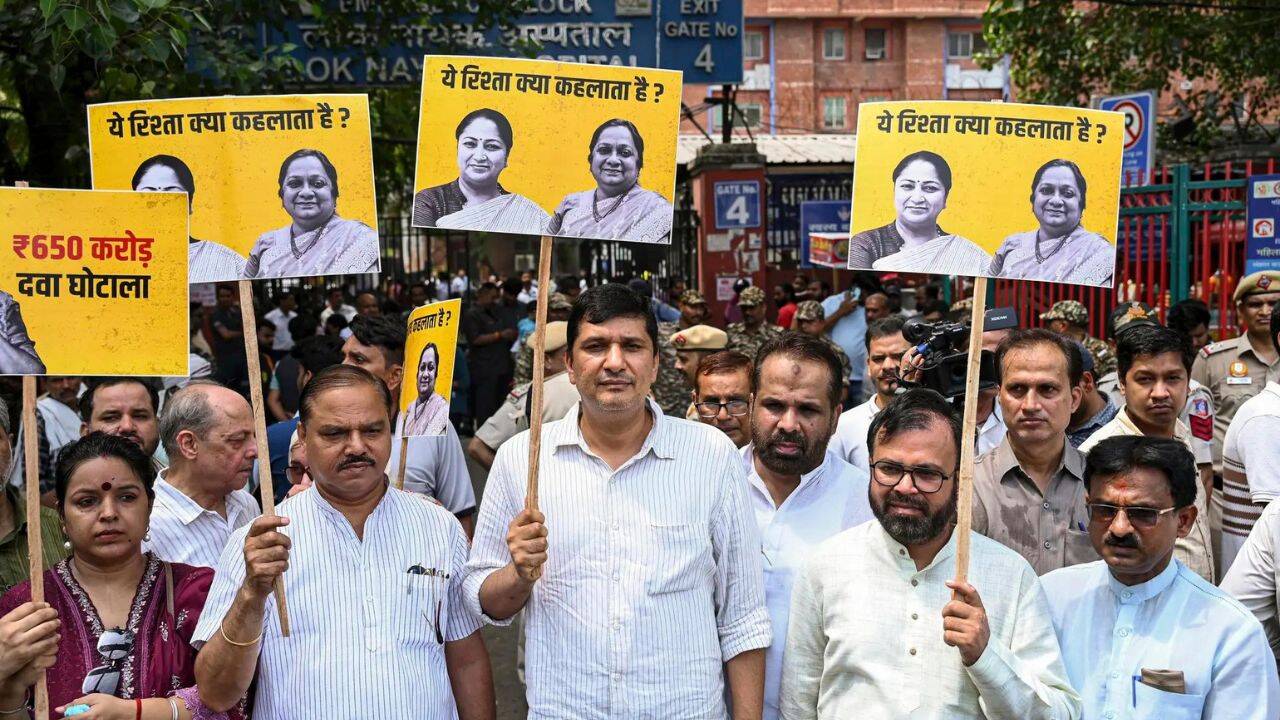
A significant political storm has erupted in the capital, with the Aam Aadmi Party (AAP) staging a vehement protest at Lok Nayak Jai Prakash Narayan Hospital (LNJP Hospital) to spotlight what they describe as a colossal Rs 650 crore scam plaguing the Delhi government's health department. The opposition party has not only alleged widespread financial impropriety but has also leveled serious accusations against the administration, suggesting complicity in allowing a key figure involved in the alleged fraud to escape the country.
The protest, a culmination of several days of heightened rhetoric and press conferences from the AAP, saw prominent party leaders and numerous dedicated workers converge outside one of Delhi’s most crucial healthcare institutions. Saurabh Bharadwaj, the Delhi president of AAP, was at the forefront, vocalizing the party’s outrage and directly challenging Chief Minister Rekha Gupta. Bharadwaj’s central contention revolved around the alleged deliberate inaction by investigative agencies that he claims led to the primary accused's unhindered departure to Germany.
"There has been a health scam of an astonishing Rs 650 crore magnitude in Delhi," Bharadwaj declared to media representatives present at the scene. He elaborated, "The principal individual implicated was not apprehended by the Anti-Corruption Branch (ACB) for an entire month, providing a clear window for them to abscond to Germany. We consistently raised this issue, holding numerous press briefings and explicitly demanding the immediate arrest of Rajiv Rangeela. Despite our persistent calls, no action was taken. The critical question remains: why? The inescapable conclusion is that there is no genuine desire from the government to pursue a thorough investigation."
The demonstration drew considerable attention, with several Members of Legislative Assembly (MLAs) including Sanjeev Jha and Kuldeep Kumar, alongside scores of party activists, joining the chorus of demands for transparency and accountability from the ruling establishment. Their unified message underscored a profound distrust in the handling of the alleged corruption and the perceived failure to protect public funds earmarked for critical healthcare services.
MLA Sanjeev Jha amplified the allegations, asserting, "A gargantuan medicine procurement scam has undeniably taken root within Delhi’s health sector. Even the ACB, a governmental agency, has reportedly quantified this fraud at Rs 650 crore. Public sentiment widely suggests that the contractor central to this scandal not only fled Delhi but subsequently exited the country. He was, by all indications, afforded the opportunity to escape in a manner eerily reminiscent of how notorious figures like Vijay Mallya and Nirav Modi were permitted to evade justice and leave Indian jurisdiction." This comparison to high-profile economic offenders who have fled India after facing significant charges resonates deeply with public frustration over perceived loopholes in the legal and administrative systems.
The mechanics of such a massive procurement scam, as conceptualized by the AAP, involve deep-seated irregularities within the supply chain for essential medicines and medical equipment. In government procurement, where tenders are floated, bids are evaluated, and contracts are awarded, there are multiple junctures susceptible to manipulation. A common modus operandi includes the inflation of prices for medicines, procurement of substandard or expired drugs, creation of shell companies as vendors, or even payment for supplies that were never delivered. A Rs 650 crore figure suggests systemic corruption rather than isolated incidents, implying a well-orchestrated scheme that could only thrive with either active connivance or gross negligence from overseeing authorities.
Bharadwaj further complicated the narrative by pointing fingers at Dr. Vatsala Agrawal, whom the ruling government had allegedly accused of orchestrating the Rs 650 crore fraud within the Directorate General of Health Services. However, AAP’s Bharadwaj swiftly countered this, presenting a contradictory claim: that it was, in fact, the government led by Chief Minister Rekha Gupta itself that had controversially appointed Dr. Agrawal to her position, expressly bypassing established procedural norms and overriding senior eligible candidates. "It bypassed those who were senior and more qualified than her. It appointed her despite the existence of a prior vigilance inquiry," Bharadwaj emphasized, suggesting a deliberate subversion of due process that potentially enabled the alleged malfeasance.
The implication of appointing an individual against whom a vigilance inquiry was already pending raises severe questions about the integrity of the selection process and the priorities of the administration. Vigilance inquiries are typically initiated to investigate allegations of corruption, misconduct, or irregularities against public servants. To proceed with an appointment under such circumstances would signify a profound disregard for ethical governance and potentially expose the system to significant risks of fraud and abuse. Such an action could be interpreted as either gross incompetence or a calculated move to install a compliant official in a critical procurement role, thereby facilitating illicit activities.
The Aam Aadmi Party has not just recently stumbled upon this issue; rather, they have been consistently highlighting these allegations over the preceding days, bringing it to the public consciousness. The matter currently falls under the active scrutiny of the Anti-Corruption Branch (ACB), an agency tasked with investigating corruption charges against government officials and public servants. The pressure on the ACB to conduct a thorough, impartial, and swift investigation is immense, given the high-profile nature of the allegations, the significant amount of public money purportedly involved, and the direct accusations of government complicity in the accused’s escape.
The role of the ACB in this context is paramount. As an independent investigative body, its credibility hinges on its ability to probe allegations without succumbing to political pressure. The claim that the main accused, Rajiv Rangeela, was not arrested for a month, allowing him to flee, casts a shadow on the effectiveness and impartiality of law enforcement agencies involved. An investigation into this alleged delay, and whether any officials deliberately impeded the arrest or facilitated the departure, would be crucial to uncover the full extent of the alleged conspiracy.
The comparison drawn by AAP leaders to Vijay Mallya and Nirav Modi is not merely rhetorical; it taps into a deeply ingrained public grievance regarding economic fugitives. Both Mallya, an industrialist, and Modi, a diamantaire, face charges of massive financial fraud and have sought refuge abroad, frustrating attempts at extradition and recovery of vast sums of money. The public perceives these cases as failures of the Indian legal and administrative systems to prevent the escape of high-profile offenders. If the allegations regarding Rajiv Rangeela hold true, it would signal a worrying continuation of this trend, further eroding public trust in the state's capacity to uphold justice and protect national assets.
The Delhi government, under the leadership of Chief Minister Rekha Gupta, now faces a formidable challenge to its reputation and administrative integrity. The health sector, in particular, is a sensitive domain, directly impacting the lives and well-being of millions of citizens. Allegations of a Rs 650 crore scam in medicine procurement imply that funds meant for essential healthcare services, potentially affecting the availability, quality, and affordability of medical supplies, may have been siphoned off for illicit gains. This directly undermines the public health infrastructure and compromises the government’s commitment to providing robust healthcare.
In a metropolitan area like Delhi, where public hospitals cater to a vast and diverse population, the integrity of the procurement system is non-negotiable. Any compromise in this system can lead to shortages of critical medicines, distribution of sub-standard drugs, or an overall increase in healthcare costs that disproportionately affect the most vulnerable sections of society. The allegations, therefore, extend beyond mere financial fraud to encompass a profound betrayal of public trust and a potential endangerment of public health.
The political ramifications of this scandal are significant. The Aam Aadmi Party, a prominent opposition force in Delhi, stands to gain political mileage by effectively positioning itself as the guardian of public interest and an uncompromising voice against corruption. Conversely, the ruling party will have to navigate intense scrutiny, providing clear and convincing explanations for the alleged irregularities, the controversial appointment, and the circumstances surrounding the accused’s alleged escape. Failure to do so could severely damage its standing and public credibility, especially in the run-up to future elections.
Investigative journalists and watchdog organizations will undoubtedly continue to press for details, scrutinizing every aspect of the alleged scam, from the tender processes and contract awards to the financial trails and the communication records within the health department. The outcome of the ACB investigation, including any arrests, charges, and subsequent legal proceedings, will be keenly watched. Should the allegations prove to be substantially true, it would necessitate a comprehensive overhaul of procurement policies and appointment procedures within the Delhi government to prevent future occurrences of similar magnitude.
Furthermore, the incident highlights the complex interplay between bureaucracy, political power, and financial interests. The claim that Dr. Vatsala Agrawal was appointed despite a vigilance inquiry suggests a calculated move to circumvent established safeguards. Such circumvention often indicates a deliberate attempt to place individuals who may be amenable to facilitating irregular transactions or who can overlook breaches of protocol, thereby creating an environment ripe for corruption. A thorough audit of all high-level appointments made within the health department over the past few years, particularly those involving any bypassing of standard procedures or existing inquiries, could reveal systemic weaknesses.
The international dimension, involving the alleged flight to Germany, adds another layer of complexity. If the accused has indeed fled abroad, it initiates a lengthy and often arduous process of extradition, requiring cooperation between Indian and German authorities. This process involves legal frameworks, treaties, and diplomatic channels, which can be time-consuming and challenging to navigate, thereby delaying justice. The very ability of an alleged economic offender to leave the country so easily, especially when under active investigation or public scrutiny, points to critical lapses in border control and intelligence sharing among various law enforcement agencies.
As the protests continue and the political rhetoric intensifies, the public eagerly awaits concrete actions and definitive answers from the authorities. The Rs 650 crore health scam allegation is not merely a political talking point; it represents a significant challenge to the principles of good governance, transparency, and accountability that are foundational to a democratic society. The resolution of this matter will undoubtedly shape public perception of the Delhi administration's commitment to fighting corruption and safeguarding the public exchequer for the welfare of its citizens.
source: Times of India