In an era preceding satellite imagery, space travel, and universally accessible visual data, the concept of a constantly spinning Earth, though mathematically understood by astronomers, remained an abstract notion for many. The ground beneath our feet felt resolutely still, offering no direct, palpable evidence of its ceaseless journey through space. How, then, could one convincingly demonstrate this profound planetary motion to an ordinary individual, stripped of complex calculations or telescopic observations? This formidable challenge was met with remarkable elegance and ingenuity in 1851 by the French physicist Léon Foucault, whose iconic pendulum experiment offered an undeniable, captivating visual proof that our world is, indeed, perpetually in motion.
Before Foucault’s groundbreaking work, the understanding of Earth’s rotation largely stemmed from astronomical observations and theoretical physics. Intellectual giants like Copernicus and Galileo had proposed a heliocentric model, and Isaac Newton’s laws of motion provided the gravitational framework that supported a rotating Earth orbiting the sun. However, these were largely inferences drawn from celestial mechanics, requiring specialized knowledge and interpretation. The everyday person had no direct, empirical means to witness this fundamental truth. It was a matter of scientific consensus based on indirect evidence, not a phenomenon that could be directly observed or felt. This intellectual gap presented a unique opportunity for a demonstration that could bridge the divide between theoretical understanding and tangible experience.
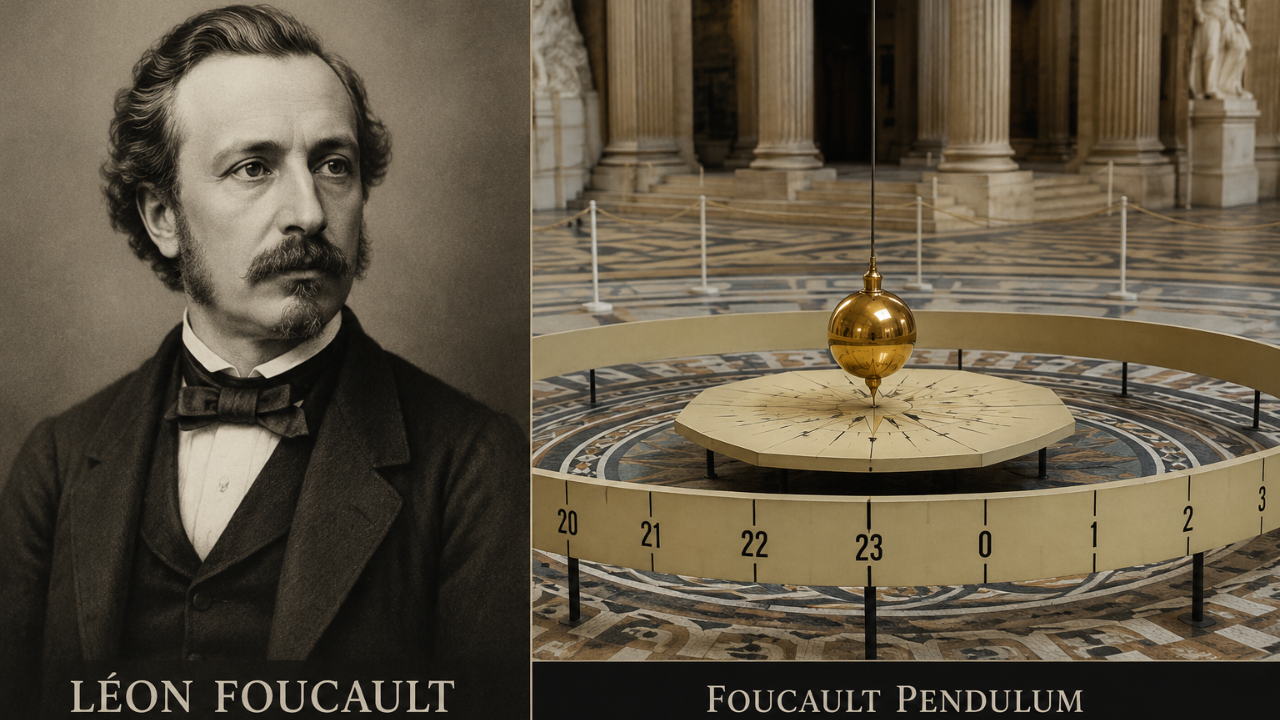
Léon Foucault, a self-taught but brilliant experimental physicist, was particularly adept at devising ingenious experiments that illuminated complex physical phenomena. Born in Paris in 1819, Foucault’s early work focused on microscopy and photography before his interests pivoted to light and mechanical demonstrations. He had already made significant contributions, including measuring the speed of light with unprecedented accuracy and inventing the Foucault knife-edge test for telescope mirrors. His inventive spirit and meticulous approach to experimentation set the stage for his most famous contribution: a device so deceptively simple yet profoundly revealing that it would forever alter public perception of planetary motion. Foucault possessed a rare talent for translating intricate scientific principles into accessible, observable realities.
The core principle behind Foucault’s pendulum is rooted in the law of inertia, a fundamental concept in physics. Imagine a pendulum swinging freely in a specific plane. If there are no external forces acting upon its plane of oscillation, it will maintain that plane indefinitely. The genius of Foucault's experiment lies in fixing the pendulum's suspension point to the Earth's surface. As the Earth rotates beneath it, the pendulum's plane of swing, thanks to its inertia, strives to remain fixed in space. From the perspective of an observer standing on the rotating Earth, however, it appears as though the pendulum's plane of swing is gradually rotating. In truth, the pendulum itself has barely altered its spatial orientation; it is the terrestrial platform below that is continuously turning. This subtle distinction is the key to unlocking the experiment’s profound implication.
For the demonstration to be effective, certain conditions are crucial. The pendulum bob must be exceptionally heavy to provide sufficient inertia, minimizing the effect of air resistance and maintaining its momentum. Concurrently, the suspension wire must be remarkably long to ensure a very slow oscillation period and to minimize external torques that could alter its swing plane. A shorter, lighter pendulum would succumb more readily to environmental disturbances and exhibit less discernible relative motion against the Earth's rotation. Foucault understood these critical parameters, meticulously engineering his setup to maximize the observable effect, transforming an abstract concept into a compelling visual spectacle.
Foucault first introduced his groundbreaking experiment to a select group of scientists at the Paris Observatory on February 3, 1851. The setup involved a relatively modest but carefully calibrated pendulum. His invitation to these esteemed colleagues contained a delightfully understated yet profoundly impactful sentence: “You are invited to come and see the Earth turn.” This bold claim, delivered with such elegant simplicity, piqued the curiosity of Paris’s scientific elite. The demonstration was an immediate sensation among those present, who witnessed firsthand the slow, undeniable shift in the pendulum’s swing plane. The clear, physical evidence resonated deeply, validating centuries of theoretical contemplation with an accessible, observable phenomenon. The news of this compelling experiment quickly spread throughout the scientific community.
The enthusiastic reception prompted an invitation for Foucault to recreate his experiment on a grander scale, accessible to the wider public, within the majestic confines of the Panthéon, one of Paris's most iconic public buildings. This marked a pivotal moment, transitioning the demonstration from a scientific curiosity to a public marvel. The scale of the installation at the Panthéon was as awe-inspiring as the underlying concept. A polished brass sphere, weighing approximately 28 kilograms (about 62 pounds), was meticulously suspended from an exceptionally long wire, extending roughly 67 meters (about 220 feet) from the cavernous dome above. Beneath this colossal pendulum, a bed of fine sand was carefully spread across the floor, allowing the brass bob to leave a visible, ephemeral trace with each oscillating sweep.
Visitors to the Panthéon, standing in hushed anticipation, observed the pendulum’s relentless, rhythmic swing. Slowly, almost imperceptibly at first, the line traced in the sand began to drift. There was no hidden motor, no unseen hand guiding its path; the pendulum itself was merely obeying the laws of physics, maintaining its plane of oscillation in space. What the multitude of spectators were witnessing was nothing short of extraordinary: the floor beneath their feet, carrying the entire city of Paris, was subtly rotating as the Earth traversed its cosmic path. Few scientific demonstrations have managed to convey such a profound astronomical truth with such minimalist apparatus and direct visual impact. The Panthéon became, for a time, a theatre of cosmic revelation, offering Parisians a direct, undeniable encounter with their planet’s dynamic reality.
The rate at which the Foucault pendulum's apparent rotation occurs is not uniform across the globe; it is intrinsically linked to the geographical latitude of its installation, a phenomenon elegantly described by what became known as Foucault's sine law. At the Earth's geographical poles (90 degrees latitude), the plane of oscillation completes a full 360-degree rotation precisely once every sidereal day – the time it takes for the Earth to complete one rotation relative to the distant stars, approximately 23 hours, 56 minutes, and 4 seconds. Here, the effect is most pronounced and direct, as the rotation of the Earth beneath the pendulum is maximal relative to its fixed plane.
Conversely, at the Earth's equator (0 degrees latitude), a Foucault pendulum would exhibit no apparent rotation whatsoever. Its plane of swing would remain fixed relative to the ground. This is because at the equator, the axis of rotation of the Earth is parallel to the plane of the pendulum's swing, meaning the Earth's rotation does not cause a perceived shift in the pendulum's oscillation. At any other latitude between the poles and the equator, the rate of apparent rotation varies proportionally to the sine of the latitude. For instance, in Paris, situated at approximately 48.8 degrees North latitude, the pendulum's plane completes a full rotation in about 32 hours. This elegant mathematical relationship underscores the intricate interplay between the pendulum's inertial properties and the Earth's spherical geometry and rotational dynamics.
This latitudinal dependency highlights a deeper physical principle at play, related to the Coriolis effect, which describes the deflection of objects moving within a rotating frame of reference. While the Foucault pendulum is not a direct demonstration of the Coriolis effect in its most common meteorological or oceanographic contexts, the underlying physics governing the apparent rotation of its plane is intimately connected to the same inertial forces that cause winds and ocean currents to curve on a rotating Earth. The pendulum's design and meticulous setup essentially create a localized, observable manifestation of these global forces, allowing even a layperson to grasp, through direct observation, the profound consequences of living on a spinning sphere. This precise relationship further solidifies the experiment’s scientific rigor and its status as an irrefutable proof of Earth's rotation.
The impact of Foucault’s pendulum extended far beyond mere scientific curiosity; it marked a significant shift in how fundamental astronomical truths were understood and communicated. Prior to 1851, the Earth’s rotation was primarily the domain of astronomers and mathematicians, a concept inferred from celestial observations and complex calculations. Foucault’s experiment democratized this knowledge, making it accessible and verifiable to anyone with eyes to see. It transformed an abstract, theoretical concept into a tangible, visceral experience. For the first time, people could stand witness to their planet’s movement without needing specialized instruments or an advanced degree in celestial mechanics. This public accessibility played a crucial role in cementing the Earth’s rotation as an undeniable, observable fact in the collective consciousness.
In the annals of scientific history, Foucault’s pendulum stands as a testament to the power of simple, yet profoundly insightful, experimentation. It demonstrated that some of the most powerful discoveries do not necessarily require colossal machinery or revolutionary inventions, but rather a keen eye, an understanding of fundamental principles, and the ingenuity to ask an old question in a new, observable way. It solidified the notion that empirical evidence, directly observed, could be just as compelling, if not more so, than complex mathematical proofs for a broad audience. This blend of elegant simplicity and profound revelation cemented its place as one of the defining demonstrations in the history of physics, influencing how scientific truths are conveyed and understood.
More than 170 years since its debut, Foucault pendulums continue to captivate and educate visitors in museums, science centers, and university halls around the globe. Despite humanity’s advancements – orbiting the Earth, landing probes on distant planets, and mapping the cosmos with unparalleled precision – these grand, swinging masses remain enduring symbols of fundamental physics. One of the most prominent Foucault pendulums, gifted by the Government of the Netherlands in 1955, hangs beneath the Visitor's Lobby ceiling at the United Nations Headquarters in New York. Here, its silent, continuous tracing of an ever-shifting path serves not only as a scientific exhibit but also as a powerful, understated reminder to thousands of visitors each year that our world is in perpetual motion.
The continued relevance of Foucault pendulums in the 21st century lies in their ability to make the intangible tangible. Unlike many scientific concepts that reside solely in equations, computer simulations, or abstract models, a Foucault pendulum is something one can stand beside, observe, and experience directly. There is no need for specialist knowledge; the evidence of Earth’s rotation quietly accumulates before one’s eyes. Spend an hour watching, return a few hours later, and the discernible shift in the pendulum’s plane unequivocally demonstrates the planet's ceaseless turning. This direct, experiential learning makes it an invaluable educational tool, sparking curiosity and fostering a deeper appreciation for the mechanics of our universe in individuals of all ages and backgrounds.
Furthermore, the installation at the United Nations headquarters embodies a broader commitment to science, education, and international cooperation. It demonstrates how a 19th-century experiment can continue to inspire wonder and foster understanding in a contemporary global context. Far from being a mere historical curiosity, the Foucault pendulum remains one of the clearest, most accessible, and most aesthetically pleasing demonstrations of fundamental physics ever devised. Its presence in such a prominent international forum underscores the universal appeal of scientific inquiry and the shared human experience of living on a dynamic planet.
In an age characterized by astonishing scientific breakthroughs often emerging from multi-billion-dollar laboratories, particle accelerators, or sophisticated orbiting spacecraft, there is something profoundly satisfying and almost humbling about the enduring power of Foucault’s simple experiment. A heavy weight, suspended by an exceptionally long wire, observed by a patient individual – these basic components are still sufficient to reveal one of the universe’s most profound truths: the world beneath our feet has never stopped turning. It serves as a timeless reminder that elegant solutions and deep insights often lie hidden in plain sight, waiting for an astute observer like Léon Foucault to uncover and demonstrate them with clarity and brilliance. The Foucault pendulum stands as an everlasting tribute to human ingenuity, bridging the gap between abstract cosmic realities and our immediate, observable world.
source: Times of India