A palpable deepening of internal divisions has gripped the Punjab unit of a major national political party, with representatives of a significant faction, predominantly aligned with former Chief Minister Charanjit Singh Channi, making a direct pilgrimage to the national capital. This move, undertaken on Monday, aimed to secure an audience with the party’s apex leadership, signaling a clear escalation in the simmering tensions that have characterized the state chapter’s organizational landscape. The delegation’s journey to Delhi followed a conspicuously orchestrated gathering in Punjab, widely interpreted as a formidable display of numerical strength by the Channi camp against the incumbent state president, Amrinder Singh Raja Warring.
This latest development unfolds against a backdrop of recent organizational restructuring by the party's central command, a strategic overhaul intended, ostensibly, to foster cohesion and re-energize the state unit in preparation for the 2027 assembly elections. However, instead of unifying disparate elements, the reshuffle appears to have inadvertently exacerbated pre-existing fault lines, bringing latent factional rivalries to the forefront. The central leadership, under the stewardship of party president Mallikarjun Kharge, had meticulously crafted new roles: Charanjit Singh Channi was appointed Chairman of the Campaign Committee, Vijay Inder Singla took charge of the Election Management and Coordination Committee, Sukhjinder Singh Randhawa was designated to lead the Core Committee, and Amar Singh assumed the chairmanship of the Manifesto Committee. Concurrently, Amrinder Singh Raja Warring was retained as the Punjab Pradesh Congress Committee (PPCC) president, with Partap Singh Bajwa continuing as the Leader of the Congress Legislature Party. This intricate distribution of responsibilities was perceived by many political observers as a delicate balancing act, an attempt to accommodate various influential leaders and their respective support bases within the party hierarchy, thereby preventing any single faction from dominating the organizational structure outright. Yet, the subsequent actions of the Channi-aligned leaders suggest that this equilibrium remains precarious, easily disturbed by perceived slights or aspirations for greater influence.
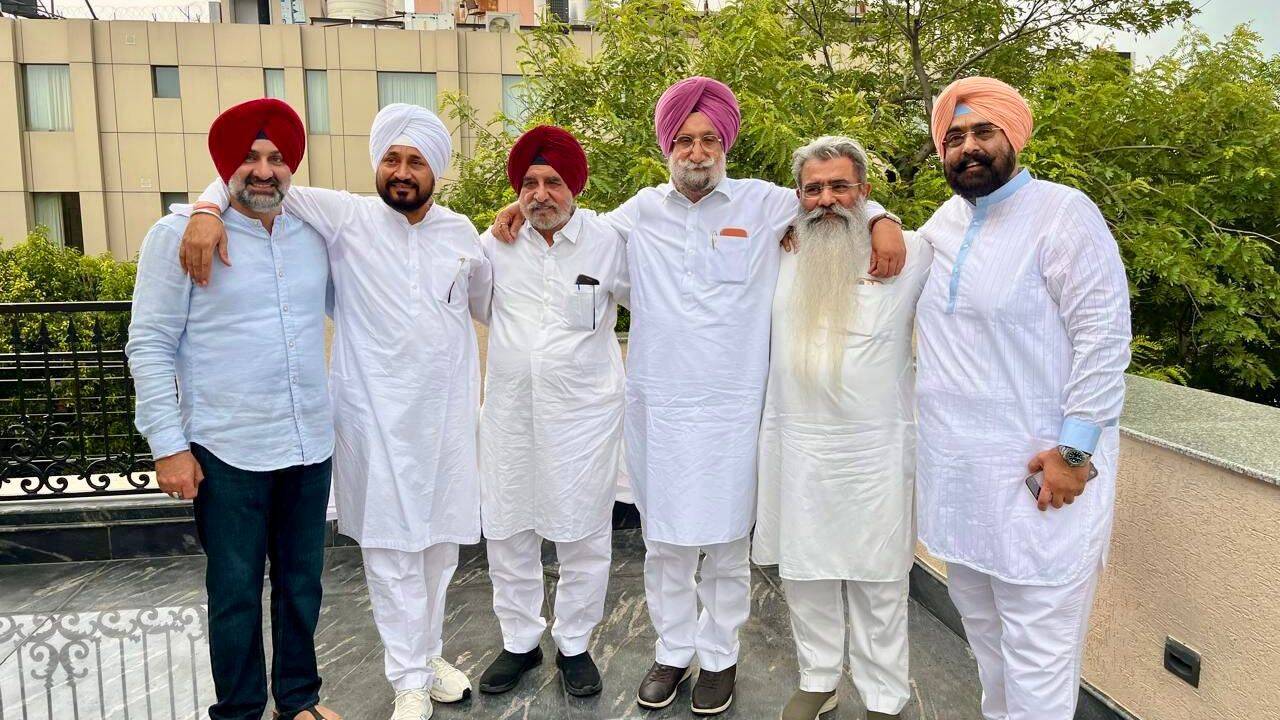
The catalyst for the most recent surge in intra-party discord was a significant meeting convened at former Chief Minister Channi’s residence in Morinda. This gathering, far from being a private consultation, quickly evolved into a powerful public statement. Among the prominent figures present were Sukhjinder Singh Randhawa, who now chairs the Core Committee, along with Manifesto Committee co-chairman and MLA Pargat Singh, and Election Committee co-chairpersons Razia Sultana and Bharat Bhushan Ashu. A substantial number of other senior party leaders and MLAs also attended, creating a visual spectacle of solidarity around Channi. The optics of this meeting were meticulously crafted, culminating in a photograph shared on social media by Sukhjinder Singh Randhawa, famously captioned: “Unity is strength.”
However, the implied message of unity was strikingly undermined by the conspicuous absence of several key figures from the Morinda conclave. Punjab Congress president Amrinder Singh Raja Warring, Leader of Opposition Partap Singh Bajwa, and MLA Sukhpal Singh Khaira were notably missing from the photograph and the gathering itself. Their absence was not merely a logistical oversight; it underscored the very schism that the meeting was, paradoxically, trying to highlight while simultaneously claiming unity. For many political analysts, Randhawa’s caption, juxtaposed with the missing leadership, served as a clear, albeit subtle, challenge to the existing power structure and a potent assertion of the Channi faction's collective strength and influence within the state unit.
Sources close to the Channi camp indicated that the Morinda meeting was not merely a welcome reception for Channi in his new role, but a strategic platform to voice discontent regarding the recent organizational appointments. It was reportedly a venue where several leaders present urged the party’s high command to reconsider some of its decisions, asserting a strong belief that the party’s best chances of regaining power in the 2027 assembly elections lay squarely under Charanjit Singh Channi’s leadership. This direct challenge to the high command's carefully considered appointments signals a profound lack of acceptance for the current power-sharing arrangement among a significant segment of the party's state leadership.
The subsequent journey of Channi’s representatives to Delhi on Monday, aimed at securing a meeting with the national leadership, further accentuated the internal rift. This move carried significant political weight, especially given that the All India Congress Committee (AICC) in-charge for Punjab, Bhupesh Baghel, was himself scheduled to visit the state. By bypassing Baghel, who is the central leadership’s direct emissary and administrator for Punjab affairs, the Channi faction effectively communicated a desire to appeal directly to the highest echelons of the party, suggesting either a lack of faith in Baghel’s impartiality or a calculated effort to exert maximum pressure from the top. The direct approach to Delhi is a classic tactic in Indian politics, often employed by state leaders to circumvent local party structures and seek redressal or affirmation from the central authority, particularly when local disputes reach an intractable stage.
In response to the escalating narrative of internal discord, Punjab Congress president Amrinder Singh Raja Warring swiftly moved into damage control mode. He vehemently refuted any suggestions of a rebellion or a deliberate schism within the party ranks. Addressing the media, Warring clarified that the Morinda meeting, while attended by many leaders, was primarily a continuation of a prior gathering at Channi’s residence and was not conceived as an act of defiance against any individual or the party leadership. He emphasized that the gathering was a routine party affair, focused on preparations for the upcoming 2027 assembly elections and aimed at strengthening the Congress party in Punjab.
Warring’s statements were characterized by a deliberate attempt to project an image of unity and dismiss the speculative interpretations of the Morinda meeting. He stated: “Channi saab (referring to Charanjit Singh Channi) has only shared his photograph and stated that the meeting held in Morinda was continued. That meeting was not against anyone. As I have already explained, the Morinda meeting was held at the residence of our senior leader, respected Charanjit Singh Channi, who has been appointed chairman of the campaign committee. Many leaders went there to welcome and meet him. Those who did not attend may do so in the coming days. Please do not exaggerate the Morinda meeting. It was held to strengthen the Congress party, and today’s meeting is also for the same purpose. Within the next couple of days, you will see all Congress leaders together on one platform.” This carefully worded rebuttal aimed to normalize the event and de-escalate the perception of an organized revolt, positioning it as a typical party gathering rather than a factional show of force.
Warring also used the opportunity to reiterate his unwavering commitment to party unity and dismissed any personal aspirations for the chief ministerial post, deferring that critical decision entirely to the party’s high command. He asserted, “The Congress is united. Our rivals can dream on, but nothing is going to happen. Channi, Warring and all others will be seen together, fighting the battle for Punjab.” He further contended that the notion of a 'rebellion' was a narrative fabricated and amplified by rival political parties seeking to exploit internal discussions for their own gain. His repeated emphasis on collective leadership and a united front reflects a strategic effort to present a cohesive image to the public and to the central leadership, countering the impression of a deeply fractured state unit. However, the actions of the Channi faction, particularly their direct appeal to Delhi, suggest that this public display of unity might be more aspirational than actual.
The current turbulence within the Punjab Congress is not an isolated incident but rather a continuation of a pattern of internal power struggles that have historically plagued the party in the state. The period leading up to and following the 2022 assembly elections, which saw a significant defeat for the Congress, was marked by intense factionalism, ultimately contributing to the party’s electoral misfortune. The dramatic change of chief ministers just months before the election, with Charanjit Singh Channi replacing Captain Amarinder Singh, was a clear manifestation of deep-seated rivalries and strategic miscalculations. While Channi was seen as a bold choice to appeal to Dalit voters, his short tenure was tumultuous, overshadowed by internal bickering and ultimately insufficient to stem the tide of the Aam Aadmi Party’s surge.
The recent organizational reshuffle, therefore, was a critical attempt by the high command to stabilize the unit and learn from past mistakes. By distributing key roles among prominent leaders, including Channi, Warring, Singla, Randhawa, and Amar Singh, the central leadership hoped to create a balanced power structure where each faction felt represented and had a stake in the party’s collective success. Channi’s appointment as Campaign Committee Chairman, a significant and visible role, was intended to leverage his public recognition and give him a substantial platform, while Warring’s retention as state president ensured continuity and administrative control. However, the current events suggest that this intricate arrangement, far from being accepted as a definitive resolution, has instead become a new battleground for influence and control.
The core of the current conflict appears to revolve around the perceived hierarchy and the extent of authority vested in each of the newly appointed positions. While Warring, as PPCC president, holds administrative sway, the Campaign Committee chairmanship, particularly when held by a former Chief Minister, carries significant political weight and a direct mandate to shape the party’s public outreach. The presence of other influential leaders like Sukhjinder Singh Randhawa, Pargat Singh, Razia Sultana, and Bharat Bhushan Ashu within the Channi camp indicates a powerful convergence of political heavyweights who believe that their collective vision and leadership style, particularly Channi’s, offers the most viable path to electoral revival.
The timing of the Channi faction’s Delhi visit also holds strategic significance. With the AICC in-charge for Punjab, Bhupesh Baghel, scheduled to be in the state, the decision to send representatives directly to the high command in Delhi underscores a profound political maneuver. It suggests an attempt to elevate the dispute to a national level, bypassing the state-level resolution mechanisms and possibly seeking a more definitive and top-down intervention. This could be interpreted as a challenge to Baghel’s authority or, at the very least, an expression of urgency that they believe only the supreme party leadership can address adequately. Such actions often put the central command in a difficult position, forcing them to arbitrate between powerful state leaders and potentially risk alienating one faction while trying to appease another.
The implications of this ongoing internal conflict for the Punjab Congress are profound, particularly as the party aims to rebuild its strength and credibility ahead of the 2027 assembly elections. A deeply divided party struggles to present a united front to the electorate, articulate a coherent agenda, or effectively counter political adversaries. This internal strife risks diverting critical energy and resources away from essential electoral preparations, such as organizational strengthening, policy formulation, and grassroots campaigning. Moreover, it provides ample fodder for opposition parties, particularly the ruling Aam Aadmi Party and the Bharatiya Janata Party, to highlight the Congress’s perceived instability and leadership vacuum.
Historically, factionalism has been a recurring Achilles’ heel for the Congress party across various states. The ability of the central leadership to deftly manage these internal tensions, enforce discipline, and ultimately project a united and purposeful image to the public will be crucial for the party’s prospects in Punjab. Failure to resolve these escalating disputes definitively could lead to further defections, demoralization among the rank and file, and a significant erosion of public trust, making the path to regaining political relevance in Punjab even more arduous.
The coming days and weeks are critical for the Punjab Congress. The central high command faces a delicate balancing act: it must address the grievances of the Channi faction without undermining the authority of the appointed state president, Amrinder Singh Raja Warring, or appearing to capitulate to factional pressure. The resolution, if any, will likely require skillful negotiation, perhaps further adjustments to organizational roles, or a stern admonition to prioritize party unity over individual ambitions. Ultimately, the future trajectory of the Punjab Congress will depend on whether its leaders can move beyond their internal squabbles and present a cohesive, determined force capable of challenging the incumbent government and reclaiming its political footing in the strategically important state.
source: Times of India