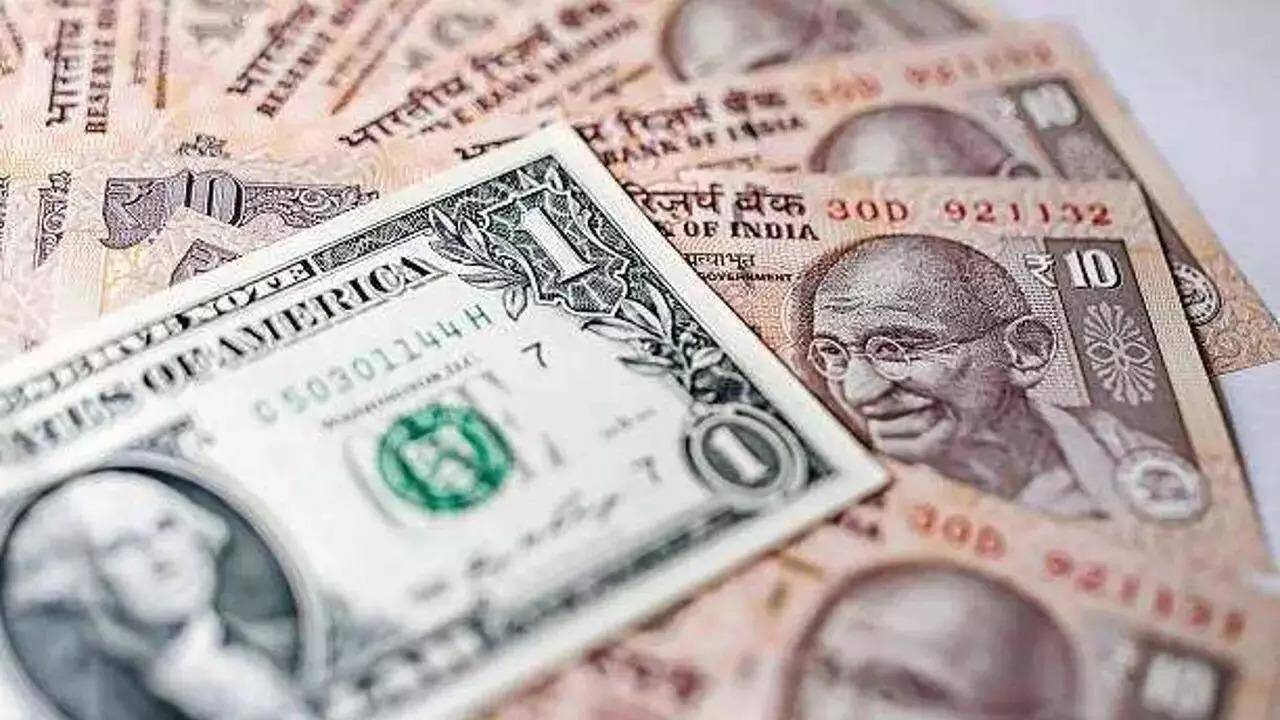
The Indian Rupee commenced the trading week under considerable duress, experiencing a notable depreciation of 10 paise to settle at 95.28 against the formidable US dollar during early Monday sessions. This initial setback for the domestic currency was primarily attributed to a confluence of international financial dynamics: an invigorated US dollar on global foreign exchange markets, coupled with an pervasive undercurrent of uncertainty stemming from ongoing geopolitical developments. These external pressures effectively counteracted several otherwise favorable domestic economic signals, thereby exerting substantial downward force on market sentiment.
Tracing the trajectory of Monday's trading, the Rupee initiated its journey in the interbank foreign exchange market at a rate of 95.25 against the greenback. However, this preliminary stability proved ephemeral, as the currency soon began to recede, eventually weakening to 95.28. This pivotal movement represented a decline of 10 paise from its prior closing valuation of 95.18 on the preceding Friday. The erosion of value effectively negated a portion of the commendable 17-paise gain that the Rupee had managed to secure in the immediate prior trading session, underscoring the volatility and sensitivity of the currency to prevailing global currents.
A critical lens through which to examine this market behavior involves the discernible strategy of India’s central banking authority. Seasoned foreign exchange traders, privy to the nuanced machinations of monetary policy, posited that the Reserve Bank of India (RBI) is anticipated to meticulously channel any fresh inflows of foreign capital into bolstering the nation’s foreign exchange reserves. This strategic prioritization suggests a deliberate intent to fortify the country's financial bulwarks against external shocks, rather than permitting the Rupee to experience a sharp, unmanaged appreciation. Such an approach reflects a cautious macroeconomic management philosophy, aimed at nurturing long-term stability over short-term currency strength. The implications of this strategy are manifold: while it might temper immediate gains for the Rupee, it concurrently strengthens the nation's capacity to absorb future economic turbulence, offering a crucial buffer against global financial vicissitudes and commodity price fluctuations.
Simultaneously, the broader financial markets remained steeped in a state of pronounced caution, a sentiment largely fueled by the persistent ambiguity surrounding the advancement of US-Iran peace negotiations. The intricate and often unpredictable nature of these diplomatic overtures injected an additional layer of geopolitical risk into the global investment landscape, consistently influencing and shaping investor sentiment. Such geopolitical uncertainties inherently heighten perceived risks, often leading to a 'flight to safety' phenomenon where capital gravitates towards traditionally secure assets, predominantly the US dollar, at the expense of emerging market currencies like the Rupee. The direct impact on the Rupee is often through foreign portfolio investor (FPI) sentiment, which can turn cautious, leading to outflows or reduced inflows, thereby pressuring the currency.
Further illuminating the underlying fragility, Amit Pabari, Managing Director at CR Forex Advisors, offered a compelling analytical perspective. He articulated that the Rupee's conspicuous inability to fortify its position, even in the presence of ostensibly favorable global cues, serves as a stark indicator of an intrinsic, pervasive weakness. Pabari’s analysis underscored a crucial observation: “The message from last week is simple. When the rupee cannot rally on good news like falling oil and a softer dollar, it tells you the underlying mood is fragile. Any fresh negative trigger could push USDINR towards the 95.80 to 96.00 zone, while support holds near 94.80 to 95.00.” This expert commentary highlights a crucial disjunction where typically supportive factors fail to translate into currency strength, thereby signaling deeper structural or psychological impediments within the market. This scenario suggests that even robust macroeconomic fundamentals might be momentarily overshadowed by risk aversion or an expectation of further external pressures, compelling market participants to adopt a defensive posture. The indicated technical levels, 95.80-96.00 as resistance and 94.80-95.00 as support, provide traders with crucial benchmarks for future movements, suggesting potential downside if negative triggers materialize, and a floor where buying interest might emerge.
The global benchmark for the US currency, the dollar index, which meticulously tracks the greenback’s performance against a carefully selected basket of six other major global currencies, registered a marginal yet significant uptick, trading 0.10% higher at 100.95. This upward movement in the dollar index is a direct reflection of the US dollar's enhanced strength on international markets, contributing significantly to the downward pressure experienced by the Indian Rupee. A stronger dollar makes dollar-denominated assets more attractive and non-dollar assets relatively less so, influencing cross-currency pairs and capital flows. The dollar's resilience often stems from its status as a global reserve currency and a safe-haven asset, particularly during periods of geopolitical instability or global economic uncertainty.
Pabari further elaborated on the peculiar market dynamics, pointing out that despite the emergence of weaker US jobs data, which typically exerts downward pressure on the dollar index by dampening expectations of aggressive Federal Reserve monetary tightening, the Rupee failed to capitalize on the concomitant softer greenback. He observed, “The dollar index eased to around 100.90 as weak US jobs data continued to weigh on it. Normally, a softer dollar is exactly what the rupee needs to catch a breath. This time, it simply did not happen, and that is the part worth watching closely this week.” This anomaly accentuates the prevailing deep-seated market apprehension, implying that even when a key external factor traditionally conducive to Rupee appreciation manifests, other overriding concerns, such as geopolitical risks or domestic policy expectations regarding RBI's intervention strategy, prevent the local currency from deriving the expected benefit. This specific divergence between expected and observed market reactions signals a complex interplay of forces, where the usual correlations may be temporarily suspended due to heightened risk perception or specific central bank policy objectives. It prompts a closer examination of the confluence of factors influencing currency movements beyond conventional economic indicators, suggesting that market participants are currently prioritizing risk mitigation and capital preservation above all else.
In the broader commodity landscape, Brent crude futures, widely recognized as the preeminent global benchmark for oil prices, registered a decline of 0.58%, trading at $71.70 per barrel. Historically, a decrease in global oil prices is typically perceived as a net positive for India, a nation heavily reliant on crude oil imports to fuel its vast economy. Lower oil prices reduce the country's import bill, thereby easing pressure on its current account deficit and, by extension, providing a supportive tailwind for the Rupee. However, in the context of the Rupee's recent depreciation, the failure of this favorable commodity price movement to translate into currency strength further underscores the overriding influence of the stronger dollar and pervasive risk aversion within the markets. This demonstrates how even fundamental economic advantages can be nullified by more dominant global financial and geopolitical tides.
Paradoxically, while the Rupee experienced headwinds, the domestic equity markets, epitomized by Dalal Street, commenced the week with a remarkably strong performance. Both benchmark indices, the BSE Sensex and the NSE Nifty, recorded impressive gains exceeding 0.4% in early trading sessions. Specifically, the BSE Sensex surged by 316.46 points, or 0.41%, to reach a robust 78,080.37, while the NSE Nifty advanced by 99.60 points, or 0.41%, climbing to 24,381.00. This divergence between a struggling currency and a buoyant equity market often indicates that foreign institutional investors (FIIs) might be selectively investing in specific Indian equities that they perceive as having strong fundamentals or growth potential, even as broader sentiment towards the Rupee remains cautious. The continued influx of foreign capital into equities, as evidenced by FIIs remaining net buyers on the preceding Friday, purchasing equities worth a substantial Rs 1,355.33 crore, underscores a nuanced investment approach. It suggests a confidence in corporate earnings and long-term growth prospects of Indian companies, even if the overall macroeconomic and geopolitical environment injects an element of caution into currency markets.
Separately, official data released by the Reserve Bank of India revealed a notable contraction in the country's foreign exchange reserves. For the week concluding on June 26, these vital reserves experienced a decline of $5.654 billion, bringing the total down to $666.933 billion. This reduction followed a more modest increase of $963 million in the preceding reporting week, during which the reserves had briefly risen to $672.587 billion. The fluctuation in foreign exchange reserves is a critical barometer of a nation's external economic health and its central bank's intervention activities. A decline typically indicates that the central bank has intervened in the foreign exchange market, often by selling dollars to prevent excessive depreciation of the local currency, or due to valuation changes of non-dollar assets held in the reserves. This latest dip highlights the RBI's continued vigilance and active management of the Rupee's stability.
It is instructive to recall the peak performance of India's foreign exchange reserves, which had soared to an unprecedented record high of $728.494 billion in the week ending February 27. Following this zenith, the reserves embarked on a protracted decline over several subsequent weeks. This period of contraction notably coincided with the escalation of the Middle East conflict, a geopolitical event that significantly amplified pressure on the Indian Rupee. In response to this intensified pressure and to mitigate excessive volatility, the Reserve Bank of India judiciously intervened in the foreign exchange market, primarily through strategic sales of US dollars. These interventions are a standard tool for central banks to stabilize their domestic currency, ensuring that a sharp depreciation does not lead to imported inflation or destabilize financial markets. The depletion of reserves from their peak to the current levels illustrates the tangible cost of these interventions, reflecting the central bank's commitment to maintaining financial stability in the face of significant external shocks. The ongoing efforts to replenish these reserves, as indicated by trader expectations, signify a proactive approach to rebuilding this crucial economic buffer, anticipating future global uncertainties and ensuring India’s robust capacity to weather them. The decline in reserves also impacts India's import cover, a measure of how many months of imports the country can finance with its foreign exchange reserves. A healthy import cover is crucial for investor confidence and credit ratings, making the RBI's focus on replenishment a strategic imperative.
The confluence of a strengthening US dollar, exacerbated by global risk aversion stemming from geopolitical tensions, created a formidable headwind for the Indian Rupee. Despite certain positive domestic indicators, such as a resilient equity market and declining global oil prices, the currency struggled to find its footing. This underscores a complex market environment where the traditional inverse relationship between some factors and currency strength appears temporarily suspended, superseded by broader global financial dynamics and central bank strategic imperatives. The Reserve Bank of India's perceived preference for reserve replenishment over currency appreciation, coupled with the lingering uncertainties in global diplomacy, suggests a cautious outlook for the Rupee in the near term. Investors and market participants will be closely monitoring the progress of international peace talks, global commodity price movements, and, crucially, the RBI's ongoing interventions and policy statements for any indications of a shift in the delicate balance of forces currently shaping the Rupee's trajectory. The resilience shown by the domestic equity markets, even amidst currency weakness, signals a nuanced investor perspective that differentiates between macro currency risks and micro-level corporate performance and growth narratives. This bifurcation highlights the multi-layered nature of financial analysis required in emerging markets like India, where local strengths can coexist with global vulnerabilities. The overarching theme remains one of watchful waiting, as external factors continue to dictate much of the Rupee's immediate future, even as domestic fundamentals show encouraging signs of strength and stability.
The current market landscape thus presents a multifaceted challenge for the Rupee, requiring an intricate balancing act from policymakers. On one hand, the need to maintain a competitive export environment could argue against excessive appreciation. On the other, a significantly depreciating Rupee risks importing inflation and increasing the cost of foreign debt. The RBI's observed strategy of utilizing fresh foreign inflows to bolster reserves, rather than allowing immediate, sharp appreciation, points towards a preference for long-term systemic stability over short-term currency strength. This approach is rooted in the understanding that robust foreign exchange reserves provide essential insulation against external shocks, giving the central bank greater flexibility in managing monetary policy and safeguarding financial stability during periods of global turbulence. It also ensures that India can comfortably meet its import obligations and external debt repayments, bolstering confidence among international investors and credit rating agencies. The strategic decision reflects a pragmatic assessment of the global economic climate, characterized by intermittent volatility and unpredictable geopolitical events. Therefore, while a stronger dollar and geopolitical jitters are immediate drivers of Rupee weakness, the central bank's pre-emptive actions are shaping a more resilient long-term financial architecture for India, even if it means foregoing some immediate currency gains. This nuanced policy framework, combined with the mixed signals from equity and currency markets, demands careful monitoring from all stakeholders.
source: Times of India