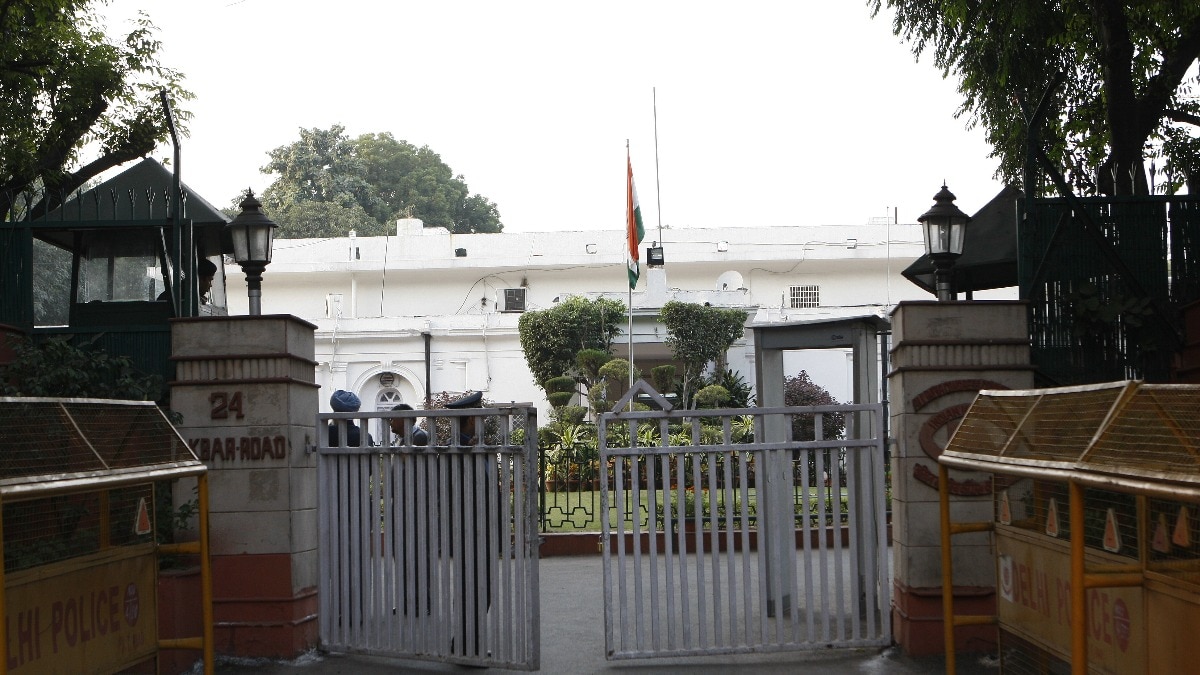
A recent and highly significant Right to Information (RTI) disclosure has brought to light a contentious issue concerning the occupation of prime government real estate in Lutyens' Delhi by a prominent national political party. The Indian National Congress, a venerable institution in India's political landscape, stands accused of having continuously occupied its former central headquarters at 24, Akbar Road for over a decade without proper authorization, incurring substantial and as yet undetermined financial liabilities to the state exchequer.
The revelations, stemming from a formal RTI application addressed to the Directorate of Estates, a pivotal agency under the Union Ministry of Housing and Urban Affairs, paint a detailed picture of the situation. According to official records, Bungalow No. 24, Akbar Road, a property with immense symbolic value nestled in the heart of the capital's elite governmental zone, was initially allocated to the Congress party on August 7, 1992. This allotment served the party as its official headquarters for over two decades, becoming synonymous with its political operations and historical narrative. However, the legal status of this occupation underwent a fundamental change on June 26, 2013, when the allotment was formally rescinded by the competent authority. Despite this cancellation, the party has, regrettably, continued to maintain its presence on the premises, an act categorized by governmental authorities as 'unauthorised occupation' since that pivotal date.
One of the most concerning aspects highlighted by the RTI response is the complete absence of any rental payments for the property throughout this extended period of unauthorized occupation. The Directorate of Estates explicitly stated that no rent has been received for 24, Akbar Road since the cancellation date of June 26, 2013. This prolonged non-payment translates into a considerable financial loss for the public treasury, essentially amounting to a decade-long waiver of revenue from a prime government asset. Furthermore, the official communication noted that the outstanding financial obligations of the Congress party are presently 'under review and yet to be determined,' indicating that a comprehensive assessment of the total recoverable amount, including potential penalties and interest, is still pending.
The implications of such an extended period of unauthorized occupation and non-payment of rent extend far beyond mere financial figures; they touch upon principles of accountability, the equitable use of state assets, and the rule of law. Government bungalows in Lutyens' Delhi are highly sought-after properties, typically allocated to ministers, members of parliament, and senior government officials on a specific tenure and subject to strict regulations. Political parties are also provided office spaces, often on concessional terms, but these allotments are invariably contingent upon adherence to stipulated conditions, including timely vacation upon cancellation or the allocation of an alternative space.
The process by which government properties are managed falls under the purview of the Directorate of Estates, an agency tasked with the monumental responsibility of administering a vast portfolio of government accommodations across India, particularly in New Delhi. This includes allocation, maintenance, and, crucially, the enforcement of tenancy rules and the recovery of dues. The cancellation of an allotment is typically followed by a series of notices urging the occupant to vacate and clear any outstanding dues. In cases of continued unauthorized occupation, the Directorate is empowered under statutes such as the Public Premises (Eviction of Unauthorised Occupants) Act, 1971, to initiate legal proceedings for eviction and recovery of damages, which can include penal rent significantly higher than the standard license fee.
In this context, the RTI applicant also sought copies of any official notices or eviction orders issued by the government to the Congress party, requesting them to vacate the bungalow. However, the Directorate declined to furnish this information, citing Section 7(9) of the RTI Act. This section permits a public authority to refuse information if 'the compilation or creation of information would disproportionately divert the resources of the public authority.' This response suggests that the records pertaining to such notices are not maintained in a readily compiled format, or that their retrieval would entail an excessive expenditure of time and resources, raising questions about the efficiency and consolidation of record-keeping within the relevant department, especially concerning such a high-profile property and occupant.
The current disclosure gains additional weight when viewed against the backdrop of earlier RTI responses concerning the very same property. A previous RTI reply dating back to 2018 had confirmed that the license fee for 24, Akbar Road had been revised to Rs 3,920 per month, effective from July 1, 2017. This earlier response had also included a copy of the 2013 cancellation letter and had acknowledged that the Congress party's request for continued retention of the bungalow and the charging of a normal license fee was 'under consideration.' The latest RTI, however, makes no mention of this 'consideration' and unequivocally states that no rent has been received since 2013, reinforcing the unauthorized nature of the occupation without any mitigating concessions.
To put the financial implications into perspective, even if one were to consider the revised license fee of Rs 3,920 per month from July 2017 until the present day (mid-2026), the cumulative amount for this period alone would run into several lakhs of rupees. This figure does not account for the period between June 2013 and June 2017, nor does it include potential penal charges, which are often significantly higher than the standard license fee for unauthorized occupation. The 'under review' status of the total dues suggests a complex calculation involving standard license fees, penal charges, and applicable interest, which can rapidly escalate the final recoverable amount into a substantial sum, potentially millions of rupees, representing a significant liability for the party and a corresponding loss of revenue for the public. The delay in determining these dues further complicates the matter, prolonging the period of non-recovery and potentially impacting the government's ability to efficiently manage its property portfolio.
The narrative of political parties and government bungalows often intersects with the broader issue of political ethics and the utilization of public resources. Lutyens' Delhi properties are not merely buildings; they are symbols of power, prestige, and institutional continuity. The ability of a major political party to retain such a property for over a decade without authorization, and without paying due rent, raises uncomfortable questions about privilege and the enforcement of rules equally across all entities, regardless of their political stature. Such situations can erode public trust in governance and foster perceptions of differential treatment.
Interestingly, the recent RTI also cast its net wider, seeking information on another historically significant Lutyens' Delhi address: 11, Ashoka Road, the former headquarters of the Bharatiya Janata Party (BJP), the current ruling party at the Centre. The Directorate of Estates confirmed that this bungalow was allotted to the BJP on March 21, 1985. However, its status has since changed, with the property now forming part of the Lok Sabha Members' Pool. Consequently, the RTI application's request for details on rent collection and the entity currently responsible for payment for 11, Ashoka Road has been transferred to the Lok Sabha Secretariat for appropriate handling, indicating a shift in the administrative control and purpose of the property.
Mirroring the situation with the Congress, the Directorate also stated that any outstanding dues of the BJP towards the government for 11, Ashoka Road are similarly 'under review and yet to be determined.' This suggests a pattern of pending financial assessments for political entities occupying government properties. Previous RTI inquiries, specifically one from 2019, had confirmed that 11, Ashoka Road continued to be in the BJP's possession as its party office at that time. Another RTI from 2018 had specified that the prescribed license fee for this bungalow was also revised to Rs 3,920 per month, effective from July 1, 2017, identical to the rate cited for 24, Akbar Road. These parallel revelations underscore a systemic challenge in the timely vacation and financial closure for government properties occupied by political parties.
The Right to Information Act serves as a crucial instrument of democratic accountability, empowering citizens to scrutinize the functioning of public authorities. These successive RTI disclosures, spanning several years, have collectively constructed a detailed timeline of the contentious occupation of these key properties, bringing transparency to aspects of government administration that might otherwise remain opaque. The Act's provisions allow for persistent questioning and have effectively pushed these issues into the public domain, demanding attention and, ultimately, resolution from the authorities concerned.
The current situation necessitates prompt and decisive action from the government. The 'under review' status for outstanding dues, for both the Congress and BJP properties, cannot be a perpetual state. There is an urgent need for the Directorate of Estates to finalize these assessments, determine the exact amounts recoverable, and initiate appropriate legal and administrative steps for recovery. This would involve a clear calculation of all arrears, penal charges, and interest, followed by the issuance of demand notices and, if necessary, the commencement of eviction proceedings and legal action for recovery of damages. The consistent enforcement of rules for all occupants, irrespective of their political clout, is paramount to uphold the integrity of public administration and ensure the judicious use of public assets.
The political implications of these disclosures are also considerable. Opposition parties will undoubtedly leverage this information to question the ruling party's commitment to accountability, while the Congress will face intense scrutiny regarding its prolonged occupation and non-payment. Such revelations fuel public discourse on ethical governance, the privileges enjoyed by political elites, and the need for stricter adherence to property laws. As India's political landscape continues to evolve, the spotlight on transparency and accountability in the management of public resources, particularly prime urban properties, will only intensify.
In conclusion, the RTI-driven expose regarding the Indian National Congress's decade-long unauthorized occupation of 24, Akbar Road, coupled with the revelation of pending dues for the BJP's former headquarters, highlights a pressing issue in the management of government properties by political entities. It underscores the critical role of transparency mechanisms like the RTI Act in bringing such matters to public attention. The path forward demands a clear and time-bound process for assessing and recovering outstanding dues, enforcing property laws without bias, and ensuring that public assets are utilized according to established regulations, thereby reinforcing public trust in the institutions of governance.
source: India Today