The global footballing spotlight converges intensely on Foxborough's Boston Stadium as outright title contenders France prepare to lock horns with the tournament's most captivating dark horses, Morocco, in a quarterfinal clash brimming with historical echoes and immense tactical intrigue. This monumental fixture is not merely another knockout round encounter; it's a tantalizing reprise of the dramatic 2022 World Cup semi-final in Doha, where France ultimately halted Morocco's astonishing fairytale journey. Four years on, Les Bleus, currently ranked as the world's premier footballing nation, enter this contest as overwhelming favorites, their formidable reputation preceding them. However, the sixth-ranked Atlas Lions have consistently defied expectations throughout this tournament, demonstrating an unwavering tactical discipline, exceptional spatial awareness, and bursts of individual brilliance that equip them with the capacity to orchestrate yet another monumental upset on football's grandest stage.
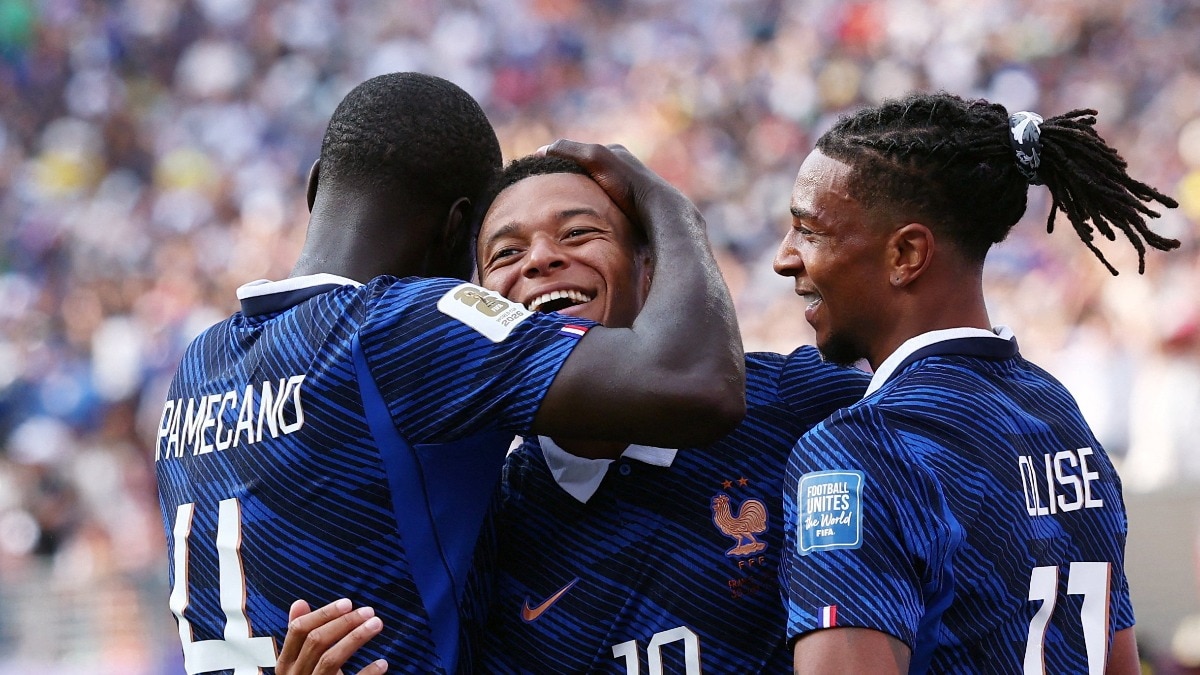
The central strategic battleground of this quarterfinal will undoubtedly revolve around how effectively Morocco’s famously unyielding defensive block can withstand and disrupt the relentless, free-flowing offensive onslaught marshaled by France’s terrifying attacking trident. This unit, featuring the electrifying Ousmane Dembele, the creative spark of Michael Olise, and the virtually irrepressible Kylian Mbappe, has been in utterly ruthless form under Didier Deschamps’ tutelage. Their combined efforts have propelled France to a remarkable tally of 14 goals across just five matches played in North America, showcasing a potency that few, if any, teams in the tournament can rival.
Kylian Mbappe, in particular, has been the undisputed vanguard of this French attacking symphony, delivering a series of performances that underscore his status as a generational talent. His form has been nothing short of sensational, as he spearheads the coveted Golden Boot race with an impressive seven goals to his name, moving him just one strike shy of Lionel Messi’s existing tally in the competition. Mbappe’s lethal finishing, often from seemingly impossible angles or through lightning-fast counter-attacks, has been perfectly complemented by the exquisite playmaking abilities of Michael Olise. Olise has emerged as the competition's leading assist provider, meticulously orchestrating chances and delivering pinpoint passes that unlock even the most resolute defenses. His vision, coupled with Mbappe's clinical execution, forms a dynamic partnership that has repeatedly torn through opponents, proving exceptionally difficult to contain.
Ousmane Dembele adds another dimension of unpredictability and explosive pace to France’s attack. His ability to operate on either flank, combined with his exceptional dribbling skills and willingness to take on defenders, ensures that opposing full-backs are constantly stretched and challenged. The collective synergy between Mbappe's directness, Olise's creativity, and Dembele's flair creates a multifaceted threat that can adapt to various defensive schemes, making France’s frontline arguably the most potent and versatile in the entire tournament. Their movement, interchangeability, and capacity to switch flanks make them a nightmare for any backline, constantly creating overloads and space.
Morocco, in stark contrast to France’s offensive exuberance, has meticulously forged its tournament success upon a foundation of structural rigidity, rapid transitional play, and an unparalleled mastery of spatial control. Their journey to this quarterfinal has been a gruelling and testament to their collective resilience, culminating in a dominant 3-0 victory over Canada in the Round of 16 – a result that sent shockwaves through the footballing world and solidified their credentials as genuine contenders. The Atlas Lions will once again rely heavily on their compact defensive lines, designed to suffocate opposition attacks and, crucially, to starve Kylian Mbappe of any meaningful space to operate. They aim to replicate the defensive masterclass that saw them successfully neutralize several footballing giants in their previous knockout runs, demonstrating a tactical maturity beyond their underdog status.
The Moroccan defensive ethos is built on a collective understanding and tireless work rate. The back four, anchored by Achraf Hakimi, who expertly balances his defensive duties with incisive attacking runs, alongside solid central defenders like Diop and Halhal, and the dependable Mazraoui, form a formidable barrier. In front of them, the midfield double pivot, featuring players like Bouaddi and El Aynaoui, plays an instrumental role in breaking up play, winning crucial second balls, and shielding the defense from direct threats. Their ability to track runners, press high, and maintain a disciplined shape has been key to their impressive defensive record, which has seen them concede minimal goals throughout the competition.
Beyond their defensive prowess, Morocco possesses the quality to launch dangerous counter-attacks. Brahim Diaz, a key figure from Real Madrid, serves as their creative fulcrum in the attacking midfield, capable of unlocking defenses with his vision and intricate passing. Alongside him, players like Ounahi and El Khannouss provide energy and technical skill, while Rahimi offers a genuine goal threat up front. Their strategy involves absorbing pressure, then transitioning swiftly from defense to attack, exploiting any spaces left by an advancing French side. This disciplined yet dynamic approach has proven incredibly effective against teams that thrive on possession and sustained pressure.
The pre-match build-up for this highly anticipated encounter has been anything but sedate, adding another layer of drama to an already charged atmosphere. Morocco's official media briefing descended into a temporary pandemonium when a physical altercation erupted between two journalists in the crowded press room. Standing stoically at the podium, Real Madrid star Brahim Diaz witnessed security personnel forcefully escort the agitated reporters out of the room. With remarkable composure, he diffused the palpable tension in the air with a disarming smile, playfully admitting, “I forgot the question!” This incident, while unusual, showcased the intense scrutiny and passion surrounding the Atlas Lions’ historic run.
Once decorum was painstakingly restored, Diaz skillfully redirected the focus back to the impending clash, particularly addressing his high-profile club teammate, Kylian Mbappe. “Kylian is a truly great player with exceptional qualities,” Diaz remarked, acknowledging his opponent’s immense talent. However, he swiftly pivoted, underscoring the fierce competitive spirit that will dominate the pitch: “But friendship and respect will cease once the match begins. I will give absolutely everything I have to help Morocco secure victory.” His words encapsulated the blend of professional admiration and fierce nationalistic pride that will fuel Morocco’s challenge.
Meanwhile, Didier Deschamps, the astute manager of the French squad, has also had to deftly navigate intense speculation and pointed questions regarding FIFA’s contentious appointment of an all-Argentine officiating crew for the quarterfinal, led by referee Facundo Tello. Brushing aside any suggestions of a conflict of interest – an understandable concern given the bitter and recent France-Argentina rivalry in international football – Deschamps adopted a characteristically sharp and sarcastic tone. He delivered a thinly veiled swipe at critics who had vociferously slammed French official François Letexier following Argentina’s controversial Round of 16 victory over Egypt, implying a double standard in the criticisms levied against referees.
“We have to deal with it. I trust the referees. Our opponent is Morocco, not the referee,” Deschamps insisted, projecting an image of calm authority and deflecting potential distractions. He then, with a mischievous glint, cheekily added: “Let’s hope our [officials] are as good as Monsieur Letexier was,” a remark that subtly underscored his confidence in his team while subtly questioning the impartiality of the pre-match narratives surrounding officiating. This exchange highlighted the psychological games that often precede high-stakes knockout matches, with coaches attempting to influence perceptions and protect their teams from external pressures.
Turning to team news, Didier Deschamps enjoys the enviable luxury of overseeing a fully fit and highly motivated squad. There are no fresh injury concerns or disciplinary suspensions following their narrow yet effective 1-0 triumph over Paraguay in the preceding Round of 16 encounter. This provides Deschamps with a full complement of his star players, allowing him complete tactical freedom and the ability to deploy his strongest XI without compromise. The continuity and stability in the French squad are significant advantages heading into such a critical match, enabling them to maintain their rhythm and tactical cohesion.
Morocco, however, has been dealt a truly catastrophic tactical blow, one that threatens to significantly impact their meticulously crafted game plan. Head coach Mohamed Ouahbi has officially confirmed that star Bayern Munich midfielder Ismael Saibari has been definitively ruled out of the quarterfinal clash. Saibari, a linchpin in the Moroccan engine room, failed to recover adequately from a severe hamstring injury sustained during their earlier match against Canada. His absence tears a gaping hole in the Moroccan midfield, a unit that relies heavily on his energy, defensive cover, and ability to transition play effectively. This injury will undoubtedly force significant tactical adjustments from Ouahbi, who must now find a way to compensate for Saibari's crucial contributions while striving to maintain their celebrated defensive stability and midfield control. The task of replacing such an influential player in a match of this magnitude presents a formidable challenge for the Atlas Lions, potentially shifting their defensive balance and transitional effectiveness. The depth of the Moroccan squad will be tested as they look to find a suitable replacement who can replicate Saibari's unique blend of defensive steel and progressive passing.
The probable starting lineup for France (4-2-3-1) is expected to feature Maignan guarding the goal, protected by a back four of Kounde, Upamecano, Saliba, and Digne. The midfield pivot will likely consist of Kon and Rabiot, providing both defensive shield and attacking impetus. Ahead of them, the formidable attacking trio of Olise, Dembele, and Barcola will support the spearhead, Kylian Mbappe. This formation emphasizes France's attacking strengths, with the wide players pushing high and Mbappe acting as the central threat, while Kon and Rabiot offer crucial balance in the middle of the park, linking defense and attack.
For Morocco (4-2-3-1), the goalkeeping duties will fall to Bounou. The defense will be anchored by Hakimi, Diop, Halhal, and Mazraoui. In midfield, Bouaddi and El Aynaoui are expected to form the defensive screen, tasked with disrupting French attacks and winning possession. The creative responsibilities in the attacking midfield will primarily rest with Diaz, Ounahi, and El Khannouss, providing support to the lone striker, Rahimi. The challenge for Morocco will be to ensure their midfield remains compact and disciplined without Saibari, to minimize the space for France's prolific attackers, and to launch effective counter-attacks through the pace and trickery of their forward players. The integration of Diaz will be key, as his ability to hold possession and pick out passes will be crucial in relieving pressure and initiating offensive sequences.
The tactical battle promises to be a captivating spectacle. Morocco’s strategy will undoubtedly focus on disrupting France's rhythm, particularly targeting the supply lines to Mbappe. This will involve a disciplined low block, intense pressing in midfield, and potentially double-teaming Mbappe whenever he receives the ball in dangerous areas. Their aim will be to frustrate the French attack, force them into wide areas, and prevent them from playing through the center. On the other hand, France will seek to exploit any cracks in the Moroccan fortress, utilizing the individual brilliance of their attackers to create chances from wide positions, through quick one-twos in the box, or long-range efforts if the defense sits too deep. The French full-backs, Kounde and Digne, will be crucial in providing width and delivering crosses, attempting to pull Moroccan defenders out of position.
The midfield tussle will also be pivotal. Kon and Rabiot for France offer a blend of physicality and technical ability, aiming to dominate possession and dictate the tempo. Bouaddi and El Aynaoui for Morocco, now without Saibari, will have an even greater responsibility to win the ball back, break up French attacks, and quickly transition the play. The team that wins the midfield battle will likely control the flow of the game and create more opportunities. Set pieces could also play a significant role, as both teams possess players capable of delivering and converting from dead-ball situations, potentially offering a route to goal when open play is stifled.
This quarterfinal is more than just a football match; it’s a narrative of champions facing an indomitable spirit, of established power against surprising resilience. France, with its galaxy of stars and a manager who knows how to navigate the pressures of knockout football, is expected to dictate play. Yet, Morocco, even with the critical loss of Saibari, has demonstrated an incredible capacity for collective effort and tactical astuteness. Their journey so far has been characterized by defying odds, and they will undoubtedly draw upon that wellspring of belief. The global football community eagerly awaits to see if the Atlas Lions can once again shock the world, or if Les Bleus' formidable offensive machinery will prove too overwhelming on their path towards ultimate glory in North America.
source: India Today