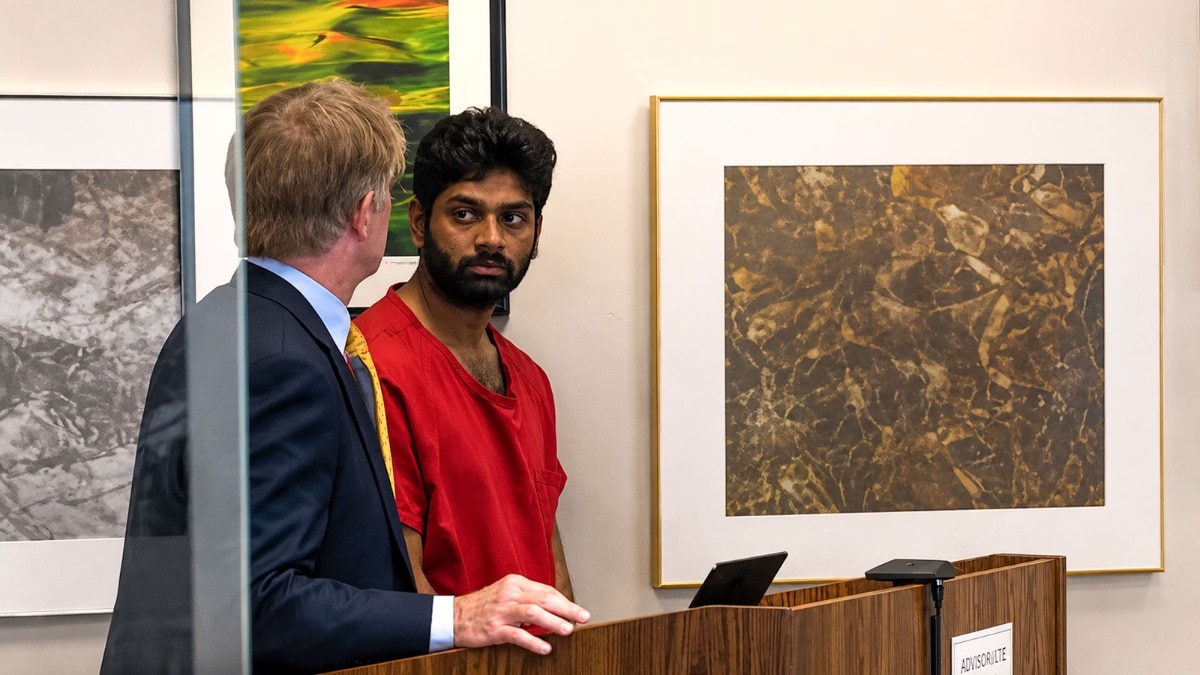
In a deeply disturbing case that has sent shockwaves through the Indian expatriate community in the United States, a 30-year-old software development engineer, Avinash Narne, originally from Telangana, has been formally charged with the murder of his 27-year-old wife, Raajitha Sabbineni. The charges, filed nearly nine months after her body was discovered, allege a meticulously planned crime, where the engineer not only strangled his spouse but then elaborately staged the apartment to deflect suspicion. This case brings to the forefront the harrowing intersection of domestic tragedy, technological surveillance, and alleged premeditation, drawing considerable attention to the complexities of modern criminal investigations.
The tragic events unfolded in late October 2025, when authorities in Bellevue, Washington, received a distress call. Narne reported that his wife, Raajitha, had locked herself inside their apartment's bathroom and was unresponsive. Responding officers, faced with an urgent situation, were compelled to force entry into the bathroom. There, they found Raajitha Sabbineni lying lifeless on the floor. She was pronounced dead at the scene, a mere six months into her marriage with Narne. The initial presentation of the scene, coupled with Narne's account, suggested a tragic and sudden collapse, potentially from illness or an accident. However, the subsequent, rigorous investigation would systematically dismantle this narrative, pointing instead to a far more sinister truth.
Crucially, the early stages of the investigation, while recognizing the immediate tragedy, did not immediately flag the death as a homicide. The initial assessment was cautious, typical of cases where the cause of death is not immediately apparent. Yet, the procedural integrity of law enforcement mandated a thorough autopsy. This critical forensic examination proved to be the turning point in the entire investigation. The medical examiner's report unequivocally determined that Raajitha Sabbineni's death was not due to natural causes or an accidental fall, but rather from asphyxia, specifically caused by strangulation. This finding instantly reclassified the case from an unexplained death to a homicide, catapulting the investigation into a high-stakes search for a killer.
With the cause of death definitively established as homicide, the investigative lens immediately sharpened, inevitably drawing focus to the only other adult present in the apartment – her husband, Avinash Narne. His narrative of leaving the apartment for errands, returning to find his wife locked in the bathroom, and then calling the police, became the central alibi to be meticulously scrutinized. Detectives, trained in identifying inconsistencies and patterns of deception, began to chip away at this story, knowing that such claims, while seemingly plausible on the surface, often contain subtle flaws that can be exposed through detailed examination. The subsequent months involved an exhaustive compilation of evidence, interviews, and, most significantly, a deep dive into the digital footprint left behind by the couple.
One of the most compelling aspects of the prosecution's case hinges on the sophisticated use of digital forensics. In an era where smart home technology is ubiquitous, residential properties often generate a wealth of data that can be invaluable in criminal investigations. Narne's apartment was equipped with a front-door security system and a smart-lock mechanism, devices designed to enhance safety and convenience but which, in this context, provided irrefutable logs of ingress and egress. Investigators meticulously analyzed the data retrieved from these systems. The records confirmed Narne's brief departure from the residence, as he had claimed. However, they critically revealed that no other person had entered the apartment during the period he was away. This digital timestamp effectively obliterated any theory of an unknown intruder gaining access to the home and committing the murder while Narne was absent, a common defense strategy in such cases. The cold, unyielding precision of the smart-lock data significantly undermined Narne's alibi, leaving him as the sole plausible perpetrator present at the time of the crime.
Beyond physical presence, the investigation delved into the digital communications and personal relationships of Avinash Narne, uncovering what prosecutors contend was a powerful motive: a clandestine romantic involvement. Court documents allege that Narne had been engaged in a
source: India Today